Amlou: The Liquid Gold of the Argan Forest
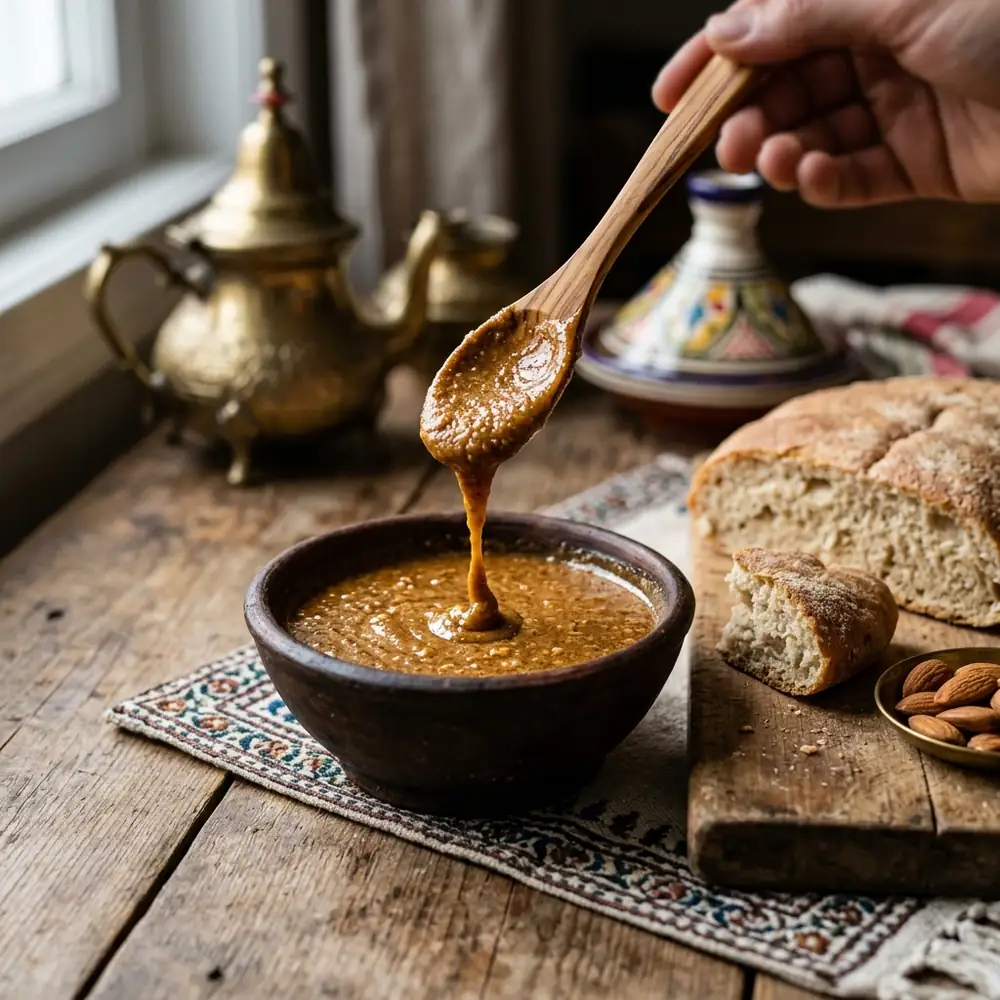
Deep in the arid Souss valley, where the ancient argan trees grow exclusively, the indigenous Amazigh people guard the secret to our most luxurious breakfast dip: Amlou. Often described as Moroccan peanut butter, this incredibly rich, sweet, and nutty spread is the ultimate expression of our ancestral culinary traditions. It is the liquid gold of the south, meant to be scooped up with hot, freshly baked bread.
What are the authentic ingredients in Moroccan Amlou?
True Amlou is an exercise in purity and rarity, requiring only three precious ingredients.
- Roasted Almonds: Ground to a fine paste using a traditional stone quern (rha).
- Culinary Argan Oil: A deeply toasted, nutty oil that can only be extracted by hand from the kernels of the argan tree.
- Pure Honey: Sourced from the orange blossoms or wild thyme of the Atlas Mountains to add a thick, natural sweetness.
The arduous labor behind culinary argan oil
Our grandmothers tell us that Amlou is expensive because it is steeped in the sweat of the Amazigh women. Extracting argan oil is a 12-century-old craftsmanship that cannot be automated. The hard argan nuts must be cracked open by hand using stones, and the inner kernels are slowly roasted over an open fire before being ground into a thick paste. The women then knead this paste by hand for hours, extracting the precious, toasted oil drop by drop.
How to serve Amlou correctly
- Because it contains no emulsifiers, the heavy almonds and honey will naturally settle at the bottom of the jar; you must vigorously stir the Amlou before every serving.
- Serve it in a small, shallow bowl alongside hot baghrir (semolina crepes) and a steaming glass of mint tea.
The Invisible Invitation
The stone mill is turning, and the scent of roasted almonds fills the warm southern air. We have poured a fresh bowl of liquid gold just for you. Come sit with us under the shade of the argan trees.
Experience the true heart of Moroccan heritage through its traditions. Join us in preserving these ancestral rituals.
What People Are Saying
No comments yet. Be the first — we'd love to hear from you.
Farisse ahmed
A Moroccan cultural writer dedicated to documenting the authentic voice, history, and heritage of the Kingdom. Writing from within — to share what truly makes Morocco extraordinary.
Our Mission →