The Architecture of a Riad: Why the Best Dining is in the Courtyard
The Architecture of a Riad: Why the Best Dining is in the Courtyard
Walk down any street in the ancient medinas of Fes or Marrakech, and you will see nothing but high, blank, windowless walls. The exterior of a traditional Moroccan home gives away absolutely no secrets.
But open the heavy wooden door, walk through the darkened, angled entryway (the bhou), and you will step into an explosion of light, color, and sound. You have entered the Riad.
The Inward Focus
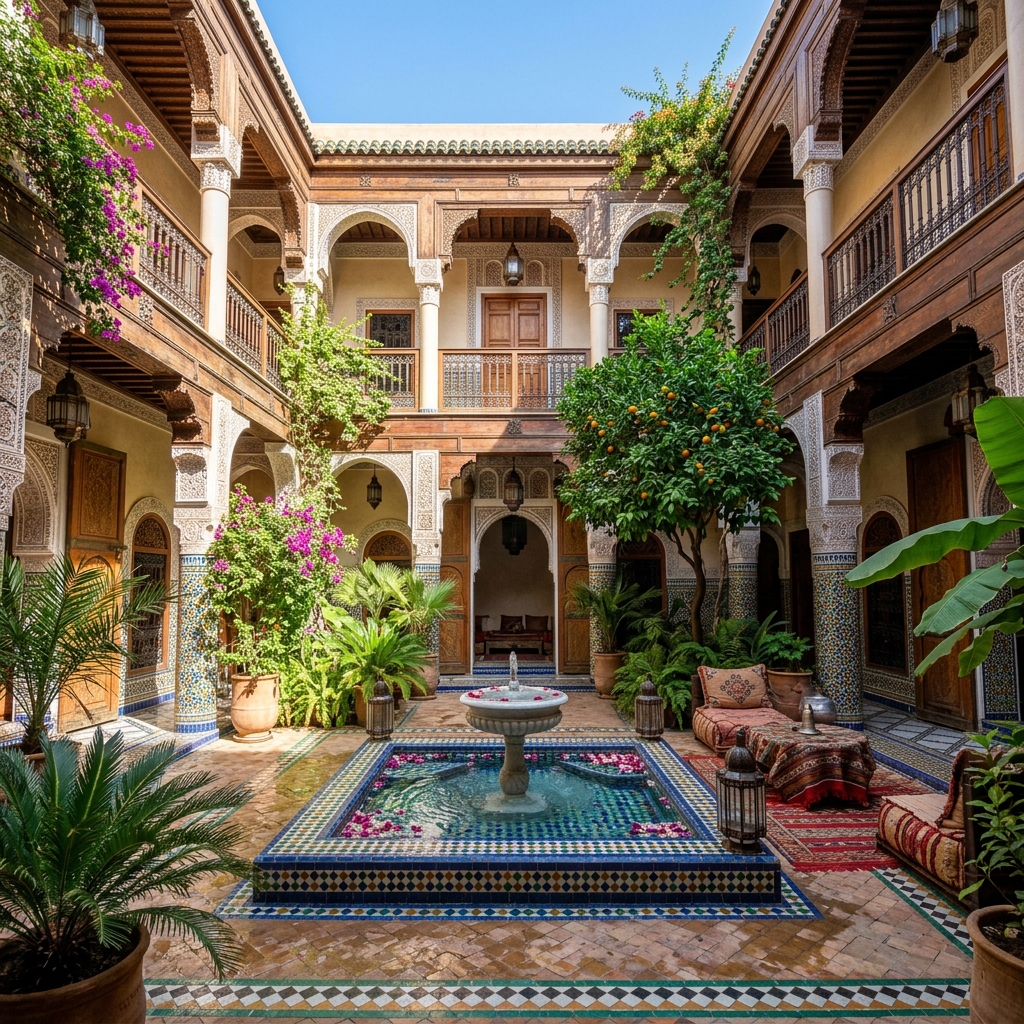
The word Riad technically means “garden,” but it refers to a traditional Moroccan house built entirely around a central, open-air courtyard. In Islamic architectural tradition, this design serves two massive purposes: absolute privacy from the outside world, and brilliant climate control.
Because the house is closed on the outside, the dust and noise of the busy souk cannot enter. Instead, the house draws all its air and light from the massive skylight in the center of the roof. Hot air rises up and out of the courtyard, pulling cool air down into the lower rooms.
The Heart of the Home
At the absolute dead center of the courtyard, there is almost always a water feature—a small tiled fountain or a plunge pool. The sound of trickling water acts as a natural acoustic shield, providing a profound sense of tranquility. The courtyard is often planted with bitter orange trees, jasmine, and mint.
This is why, in a traditional Moroccan home, the dining room is rarely used for major family meals. The family eats in the courtyard, seated on low, velvet-covered banquettes. You are dining in a private, scented garden, surrounded by intricate Zellij tilework, with the open sky above you. It is a masterpiece of domestic design that elevates a simple meal into an act of sanctuary.
Experience the true heart of Moroccan heritage through its traditions. Join us in preserving these ancestral rituals.
What People Are Saying
No comments yet. Be the first — we'd love to hear from you.
Diafa Editor
A Moroccan cultural writer dedicated to documenting the authentic voice, history, and heritage of the Kingdom. Writing from within — to share what truly makes Morocco extraordinary.
Our Mission →