Argan Oil: What Nobody Tells You About Morocco's Most Famous Export
Argan Oil: The Honest Guide to Morocco’s Most Misunderstood Ingredient
I’m going to say something that will upset some people in the Moroccan tourism industry: most of the argan oil sold to visitors is not what it’s described as. It’s either cosmetic oil being sold as culinary, it’s mixed with other cheaper oils, or it was pressed months ago and has already lost most of what makes it extraordinary. Genuine culinary argan oil — freshly pressed, roasted, cold-pressed from hand-cracked nuts by a women’s cooperative in the Souss Valley — is genuinely one of the most extraordinary edible oils on Earth. But finding the real version requires knowing exactly what you’re looking for.
Let me give you the actual information.
What Is the Difference Between Culinary and Cosmetic Argan Oil?
This is the foundational distinction and most people who buy argan oil never learn it.
Cosmetic argan oil is cold-pressed from raw, unroasted argan kernels. The absence of roasting means no aroma develops — cosmetic argan oil is pale gold and nearly odorless. This is what your body absorbs through skin and scalp. Pouring it on food produces nothing of culinary value because there is no flavor.
Culinary argan oil is cold-pressed from kernels that have first been roasted in a flat iron pan over a low charcoal or wood flame, stirred continuously by hand until they turn a deep walnut brown. The roasting develops the Maillard reaction compounds — the same chemistry behind roasted coffee and toasted bread — that give culinary argan oil its distinctive warm, nutty, slightly smoky character. The smell, when you open a bottle of freshly pressed culinary argan oil, is deep and immediate. Something between roasted sesame and toasted almonds, with a rawness underneath that is hard to place but impossible to forget.
Pouring cosmetic argan oil on your couscous would be like pouring hair serum on your food. Different product. Same source material. Never interchangeable.
Where Does Real Argan Oil Come From and Why Can’t It Be Made Elsewhere?
The Argania spinosa tree grows in one place on Earth: a roughly 8,000-square-kilometer arc of semi-arid landscape in southwestern Morocco, running from the Atlantic coast inland through the Souss Plain toward the Anti-Atlas mountains. UNESCO designated this area a Biosphere Reserve in 1998. The trees live for up to 200 years. Their root systems go extraordinarily deep — fifteen to twenty meters in some cases — searching for groundwater in conditions that would kill most other trees. They are what prevent the Sahara from advancing further into the Souss Valley.
You cannot grow them effectively anywhere else. Attempts have been made in Israel, Australia, and the American Southwest. The trees survive but they don’t fruit adequately because the specific combination of soil composition, diurnal temperature variation, and groundwater depth present in the Souss is not reproducible. The argan grove is not just a source of oil. It is a geological coincidence.
How Do Women’s Cooperatives Actually Make Argan Oil?
The work begins with the harvest — between June and August, when the argan fruit (which looks like a large, hard olive) falls from the trees and is collected from the ground or directly from branches. Traditionally, and still in some areas, goats were allowed to climb the argan trees (and they do climb them — goats in argan trees are a genuine Moroccan sight and not staged for tourists) and eat the fruit, then the nuts were collected from their droppings. The stomach acid actually improved the oil yield slightly. Modern cooperatives collect the fruit directly.
Inside a cooperative workshop, the process goes: fruit is dried and the outer flesh removed, revealing the hard nut inside. The nut is cracked between two flat stones held in the palms — a skill that takes months to learn without crushing the kernel inside, because the nut is among the hardest plant materials in the world — and the kernels sorted and cleaned.
For culinary oil, the kernels go into the roasting pan. A woman stirs them continuously over a low charcoal flame — you cannot leave the pan unattended for more than thirty seconds or the kernels burn and the batch is ruined. The smell at this stage is extraordinary. When they’ve reached the right color — deep toasted brown but not black at the edges — they come off the heat immediately and cool briefly.
Then they go into the stone grinder. The cold-grinding releases a thick paste, which is then kneaded by hand with small additions of warm water to gradually coax the oil to separate out. This kneading takes 45 minutes to an hour of continuous physical work per batch.
The oil that seeps out is filtered, collected, and bottled. One litre of culinary argan oil represents approximately 30 kilograms of raw fruit and somewhere between 12 and 15 hours of women’s labor. That is the true price of the bottle. Whatever it says on the label in the supermarket is a lie by commission.
What Is Amlou and Why Is It the Most Important Thing You’ll Eat in the Souss?
Amlou is argan oil’s greatest culinary application and it is almost entirely unknown outside Morocco. It is a thick paste — closer in consistency to natural peanut butter than to oil — made from three ingredients in approximately equal parts: roasted and ground almonds, pure unpasteurized honey, and culinary argan oil.
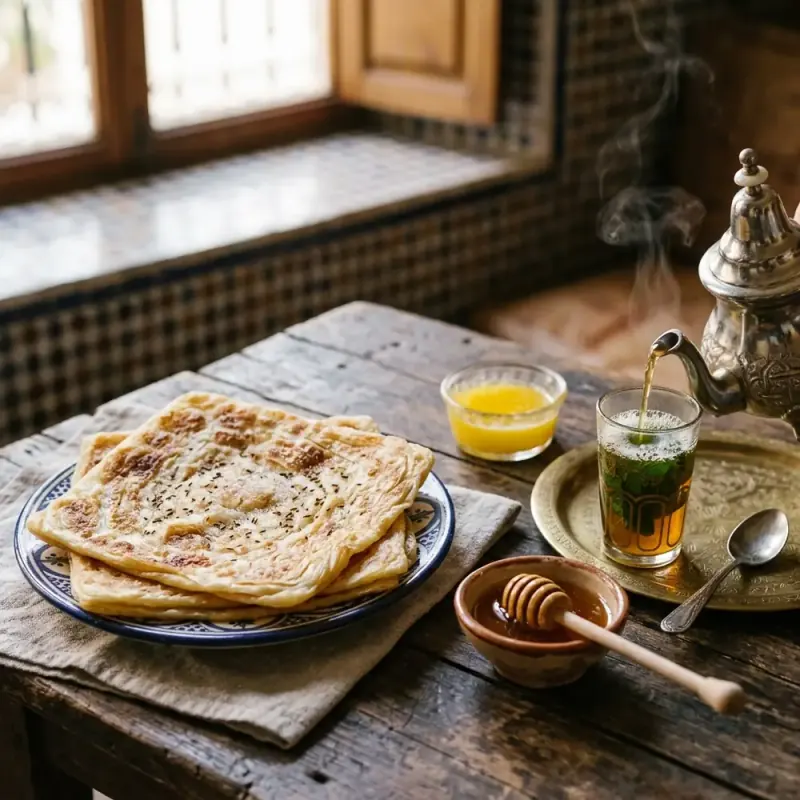
These three things are beaten together until they form a smooth, glossy, amber-brown paste that is spreadable but not liquid, nutty but not sharp, sweet but not cloying. It is served at Amazigh breakfast tables in the Souss and Atlas regions with fresh Khobz bread and a glass of argan oil drizzled separately for dipping. If you have never tasted amlou with good bread and fresh morning tea, you have a gap in your food education that needs addressing.
The Invisible Invitation
It is 7:30 in the morning in a cooperative workshop outside Tiznit. The charcoal was lit an hour ago and the room is already warm with the smell of roasting kernels. Three women are working the stone grinder in rotation — one kneading the paste while the other two crack nuts on flat stones with a steady, unhurried rhythm that sounds almost musical after five minutes. A small jar of yesterday’s pressing sits on the shelf near the door. The woman closest to you unscrews the cap and tips a few drops onto your wrist before you can protest. It smells like toasted almonds and something older, earthier, underneath. “Taste,” she says. This is where it begins.
SEO Meta Description: What is culinary argan oil vs. cosmetic? A Moroccan food expert’s guide to genuine argan oil production, Amlou paste, and why most argan oil sold abroad isn’t what it claims.
Experience the true heart of Moroccan heritage through its traditions. Join us in preserving these ancestral rituals.
What People Are Saying
No comments yet. Be the first — we'd love to hear from you.
Khadija Tahiri
A Moroccan cultural writer dedicated to documenting the authentic voice, history, and heritage of the Kingdom. Writing from within — to share what truly makes Morocco extraordinary.
Our Mission →