Friday Couscous: The Sacred Meal That Unites Every Moroccan Family
The Moroccan Friday Couscous: A Pillar of Family, Faith, and Flavor
I can tell you the exact smell of Friday in Morocco: a warm, nutmeg-tinged steam rising from a hand-rolled mound of semolina, flanked by seven vegetables and a generous shoulder of lamb so tender it falls apart with the gentlest touch. This smell is not just food. It is my childhood. It is every Moroccan’s childhood.
Friday Couscous (Couscous Jomoa) is more than a recipe — it is the weekly heartbeat of the Moroccan family. From the Atlantic coast to the edge of the Sahara, from the Rif mountains to the medinas of Marrakech, every Friday, the same ritual unfolds in every kitchen of the Kingdom.
Why Friday? The Spiritual Connection
Friday (Jomoa in Darija) is the holiest day of the Islamic week — the day of the congregational prayer (Salat al-Jomoa). After the prayers end, every man, woman, and child in Morocco knows: it is time to go home for couscous.
The tradition is rooted in centuries of Islamic scholarship that encouraged communal eating on Fridays. In Morocco, this evolved into an unbreakable social institution. Moroccan families will travel hours to be home for the Friday meal. Business meetings are not scheduled. Obligations yield.
The table is the mosque of the family.
The Architecture of the Perfect Moroccan Couscous
Authentic Moroccan couscous is not a simple dish. It is an orchestrated performance involving multiple techniques learned over generations.
The Semolina: Hand-Rolled is Non-Negotiable
My mother wakes up at 7:00 AM on Fridays. She begins by spreading the raw semolina on a large flat clay dish (Gsaa) and begins rolling it — adding water drop by drop with one hand while working the grains in a circular motion with the other. This process, repeated two or three times with drying in between, creates the hand-rolled pellets that are the soul of authentic couscous.
The box of pre-made couscous from the supermarket is a different food entirely.
The Seven Vegetables: A Rule of Abundance
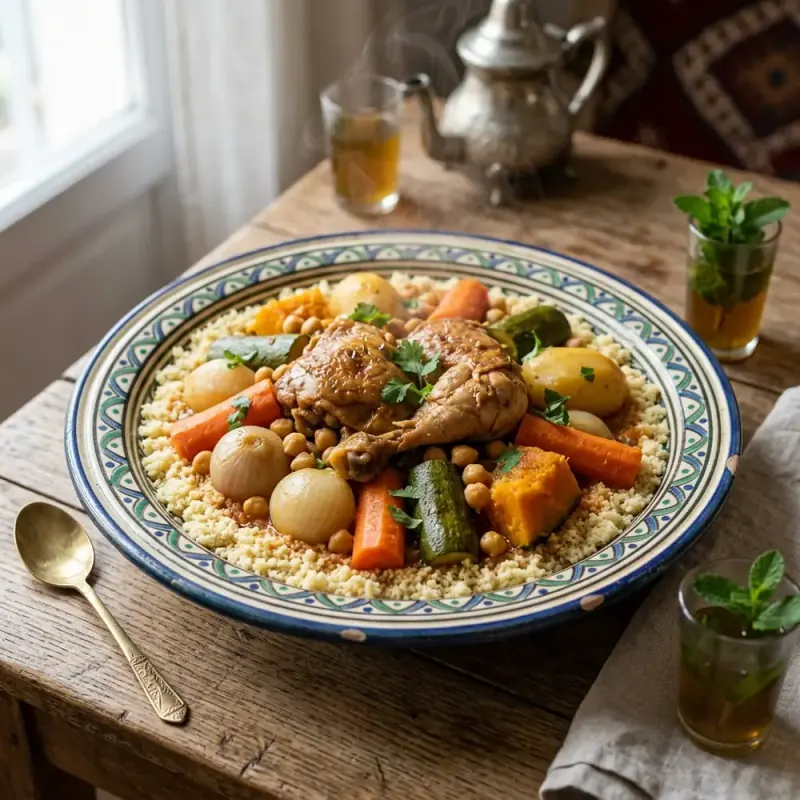
The Moroccan couscous is served with seven vegetables (Sba Khudra) — seven being a number of blessing in Islamic tradition. A classic selection includes:
- Turnip — the winter root that absorbs the broth most beautifully
- Carrot — for sweetness and color
- Zucchini (Qara) — soft and gentle
- Cabbage — for body
- Pumpkin — adds a natural richness
- Onion — the backbone of the flavor
- Chickpeas — the protein partner, cooked separately and added on top
The Meat: Lamb is King
The traditional choice is a lamb shoulder or neck, slow-cooked in the broth below the couscous steamer. As the steam from the broth rises through the perforated bottom of the Kiskas (couscous steamer), it simultaneously cooks the semolina and perfumes it with the essence of the meat. By the time lunch is served, the two components — semolina and broth — have been in a conversation for three hours.
The Ritual of Serving
On Friday, the couscous is not plated individually. It is served on a single massive communal dish called a Tbek. The mountain of semolina is shaped by hand, the vegetables are arranged in a careful geometric pattern over the top, and the meat is placed at the crown.
Everyone gathers around the same dish. You eat from the section directly in front of you, using a spoon or your hand. The gesture of pushing the best piece of meat toward your neighbor is one of the most eloquent acts of Moroccan generosity.
After the meal, a prayer of thanks is spoken. Then the Atay is prepared.
The Meal That Cannot Be Replaced
UNESCO inscribed Moroccan couscous onto the list of Intangible Cultural Heritage of Humanity in 2020 — alongside Algeria, Tunisia, and Mauritania. But for us Moroccans, no certificate was ever needed. The knowledge that every single Friday, across the entire Kingdom, we are all sitting down to the same meal, connecting us from Tangier to Lagouira — that is heritage enough. Prepare a warm plate and share it with your loved ones this Friday.
Frequently Asked Questions (FAQ)
Q1: Can couscous be made the night before? A: The semolina can be pre-rolled and partially steamed the night before, but the final steam and the full broth should always be done fresh on the day. Pre-made couscous that sits overnight loses its light, fluffy texture.
Q2: What is the difference between Moroccan and Algerian couscous? A: While both are delicious, Moroccan couscous tends to be richer in spice (ginger, saffron, turmeric) and uses lamb or chicken as the primary protein. Algerian versions often incorporate more tomato-based sauces. The technique of hand-rolling, however, is shared across the Maghreb.
Q3: Is couscous gluten-free? A: No. Couscous is made from semolina, which is a form of wheat. It is not suitable for people with celiac disease or gluten intolerance.
Experience the true heart of Moroccan heritage through its traditions. Join us in preserving these ancestral rituals.
What People Are Saying
No comments yet. Be the first — we'd love to hear from you.
Fatima-Zahra Benali
A Moroccan cultural writer dedicated to documenting the authentic voice, history, and heritage of the Kingdom. Writing from within — to share what truly makes Morocco extraordinary.
Our Mission →