Fes el-Bali: Inside the World's Largest Living Medieval City
Fes el-Bali: Why the World’s Oldest Living City Is Unlike Anything Else on Earth
Here is the thing people get wrong about Fes. They arrive having read about its UNESCO status and its medieval architecture and they prepare themselves for something museum-like — a preserved, curated glimpse of the past, respectfully roped off. A historical experience.
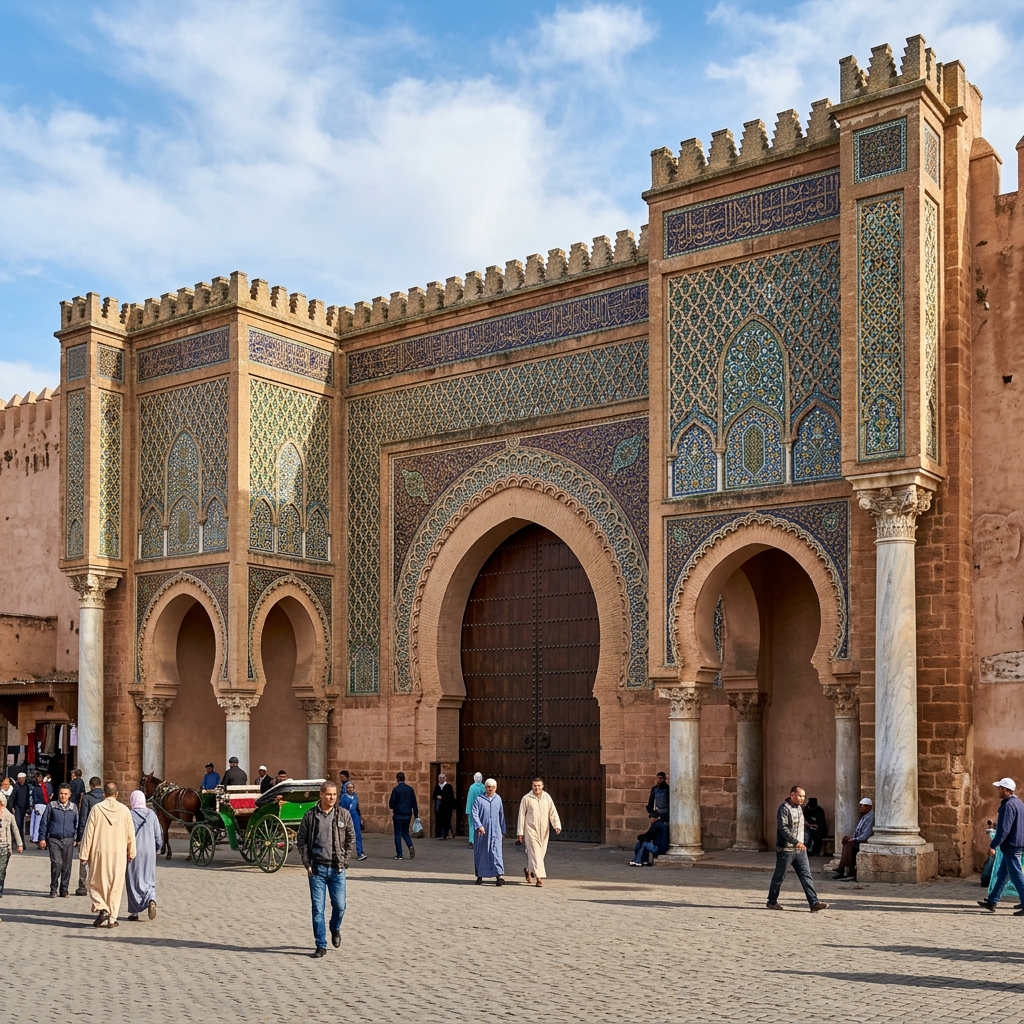
Then they walk through Bab Bou Jeloud.
And a donkey nearly runs them over.
Fes el-Bali is not preserved. It is not curated. It is not a museum. It is a city of approximately 150,000 people who wake up every morning, argue with their neighbors, get their children dressed, buy their bread from the communal oven, and live — fully, noisily, chaotically — inside walls that were established in 808 CE. The past here is not behind glass. The past here is the taxi driver. It is the tannery worker with permanently orange-stained forearms. It is the fourteen-year-old on his phone sitting in the doorway of a 13th-century mosque.
Why Does Fes el-Bali Have No Roads?
Because Moulay Idris II, who founded the city in 808, didn’t plan for the car. He planned for the human body moving through a city on foot, for the mule carrying goods from the souk to the home, for the narrow covered street that gives shade in summer and shelter in winter. The result is a street plan of staggering complexity — over 9,400 named and unnamed streets, alleys, dead ends, and passages — that has been navigated by its residents for over a thousand years entirely by memory and by the landmarks that only a local would recognize.
The streets of Fes el-Bali are not just car-free because they are too narrow for modern traffic, though they are. They are car-free because a city designed for human movement at human pace doesn’t need them. Everything that needs to be moved through Fes moves by foot or by mule. The mules know the routes. Genuinely. The delivery mules of the medina will follow their route without direction, stop at their usual stops, and wait. They have been doing this longer than most taxi drivers have been driving.
Getting lost in Fes is, incidentally, not a mishap. It is the design. The medieval labyrinthine layout was an intentional defense strategy — a city that confuses strangers cannot be easily invaded. And it works. Excellently. On tourists especially.
What Is the University of Al-Qarawiyyin and Why Is It Important?
Founded in 859 CE — let that year sit with you for a moment — the University of Al-Qarawiyyin in Fes holds the Guinness World Record as the oldest continuously operating university in human history. Oxford was founded in the 11th century. Bologna, considered Europe’s oldest, opened in 1088. Al-Qarawiyyin was already two centuries old by then.
What is often glossed over is who founded it. Not a king. Not a caliph. A woman named Fatima al-Fihri, the daughter of a wealthy Tunisian merchant family who had settled in Fes. She dedicated her entire inheritance to building the mosque-university complex that would become the intellectual capital of the medieval Islamic world, drawing scholars from across the Maghreb, Andalusia, and sub-Saharan Africa.
She gets a street named after her in Fes. But she deserves considerably more.
The university still operates. You cannot visit it as a tourist — it is an active institution of Islamic scholarship, not a monument — but you can walk around its exterior walls in the medina’s Qarawiyyin district and understand, from the sheer scale of the thing, what it means for a city to have been a center of world learning for twelve consecutive centuries.
What Are the Chouara Tanneries and How Do They Still Work?
They work exactly as they did in the 11th century. That is the answer, and it is both the most extraordinary and the most physically demanding fact about Fes.
The Chouara tanneries — the largest and oldest leather tannery complex in the world — sit in the northern quarter of the medina. From the rooftop terraces of the surrounding leather shops, you look down into a grid of circular stone vats dug into the ground, each roughly the size of a large bathtub, each filled with a different substance in a different color: white lime paste for hair removal, white dove-dung solution for softening, then the dye vats — poppy red, saffron yellow, indigo blue, walnut brown.
The workers stand in the vats. Up to their knees, sometimes their thighs. Stomping the hides, lifting them, soaking them, turning them by hand in the solution. In January, when the temperature in Fes drops, you understand immediately why they work in short sleeves — the physical labor generates extraordinary heat.
They give you a sprig of mint to hold under your nose before you look over the terrace wall. This is not a decorative gesture.
The finished leather from Chouara goes into the Babouche slippers, the handbags, the belts sold throughout the medina. Every piece you hold in a Fes leather shop began in those vats. Handled by hands that were in cold lime paste at seven in the morning.
The Invisible Invitation
Walk into Fes through Bab Bou Jeloud — the enormous blue-tiled gate on the western edge of the medina — at about ten in the morning on a weekday, when the tourist groups haven’t fully arrived yet and the city is doing what it normally does. Follow the smell of fresh bread to the nearest communal farran oven. Buy a round loaf, still warm, for eight dirhams. Stand in the alley and eat it. Let the city happen around you. Nobody is performing for you. Nobody is adjusted for your benefit. This is simply what it looks like when a medieval city decides, twelve centuries in a row, to keep going.
SEO Meta Description: What makes Fes el-Bali the world’s oldest living city? A historian’s guide to Al-Qarawiyyin, the Chouara tanneries, and the 9th-century medina that never stopped.
Experience the true heart of Moroccan heritage through its traditions. Join us in preserving these ancestral rituals.
What People Are Saying
No comments yet. Be the first — we'd love to hear from you.
Omar Idrissi
A Moroccan cultural writer dedicated to documenting the authentic voice, history, and heritage of the Kingdom. Writing from within — to share what truly makes Morocco extraordinary.
Our Mission →