Argan Oil: What It Actually Is, How It Is Made, and Why the Tree-Climbing Goats Are Not the Story
Argan Oil: Separating the Real Process From the Marketing Myths
Let us start by addressing the goats. The image of goats standing in the branches of an argan tree is the most widely circulated visual associated with Moroccan argan oil. It is true that goats in the Souss region climb argan trees to eat the fruit. It is also true that in the past, the nuts recovered from goat dung were sometimes used for oil extraction because the goats had performed the difficult work of removing the fleshy pulp. However, oil produced this way has a distinct, unpleasant animal odor, and the modern commercial argan industry — particularly the women’s cooperatives that produce high-quality export oil — strictly avoids it. The goats are now primarily a tourist spectacle, encouraged by local farmers who charge for photographs. They are not the mechanism of quality argan production.
The real story of argan oil is less about animals and more about human labor, specific geography, and the absolute distinction between its culinary and cosmetic forms.
Where Does Argan Grow and Why Only There?
The argan tree (Argania spinosa) is endemic to a specific region of southwestern Morocco — roughly bounded by Essaouira to the north, the Anti-Atlas mountains to the east and south, and the Atlantic to the west. Attempts to cultivate it commercially elsewhere in the world (including Israel and Mexico) have not produced yields comparable to the Moroccan biosphere, where the tree’s deep root system and tolerance for extreme heat and drought allow it to thrive in conditions that defeat most other agriculture.
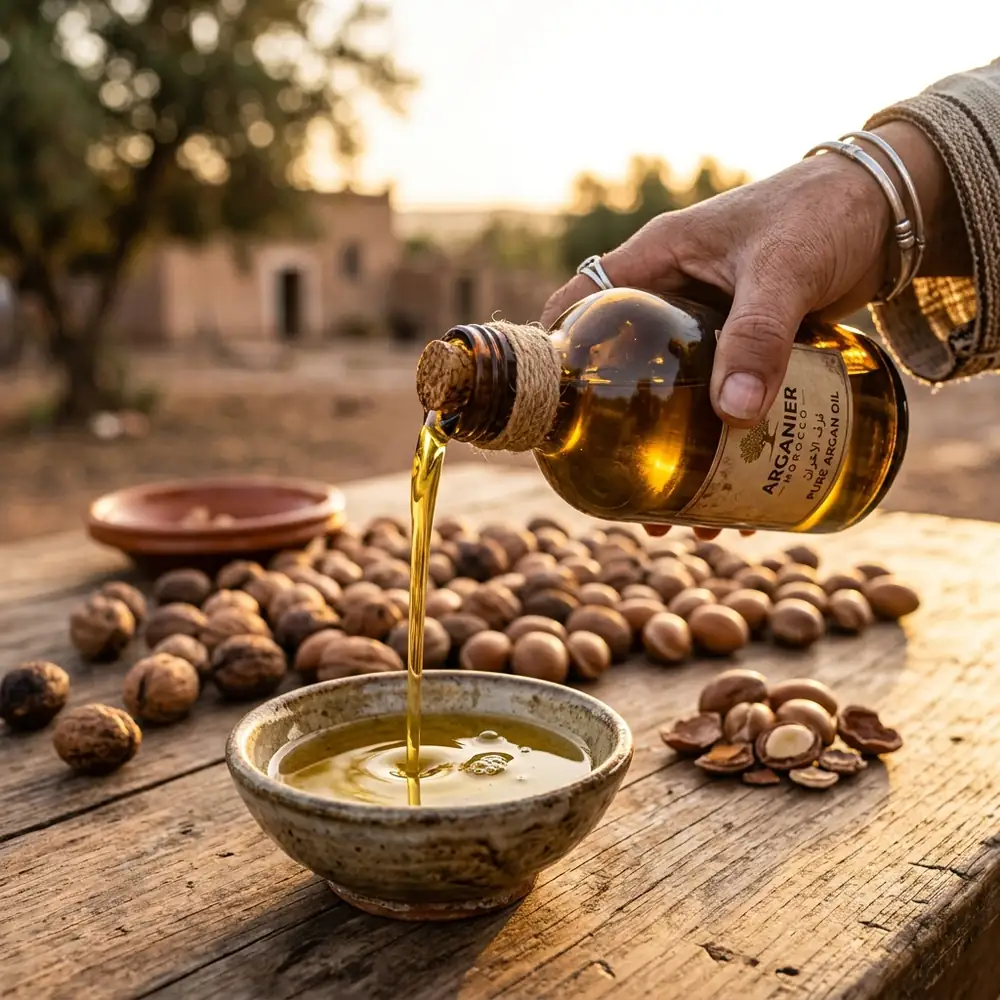
The tree produces a fruit resembling a green olive, slightly larger and rounder. Inside the fleshy pulp is a hard-shelled nut, and inside that nut are one to three small, oil-rich kernels. The extraction of those kernels is the bottleneck of argan production.
The Labor: Why Argan Costs What It Costs
There is currently no machine that can reliably crack the argan nut without crushing the delicate kernel inside. The shells are exceptionally hard, and the extraction must be done by hand.
This is the work of the women’s cooperatives in the Souss region. A woman sits with a flat stone anvil and a striking stone. She places the nut on the anvil and strikes it with exactly enough force to fracture the shell but not crush the kernel. This motion is repeated thousands of times a day. It takes approximately thirty kilograms of argan fruit and fifteen hours of this specific, skilled hand-cracking labor to produce enough kernels for one liter of oil.
When you buy cheap argan oil, you are either buying oil that has been heavily diluted with sunflower or almond oil, or you are buying a product where the labor that produced it was not fairly compensated. Genuine, pure argan oil cannot be cheap because the manual labor required to extract the kernels cannot be bypassed.
Culinary vs. Cosmetic: The Roasting Difference
This is the most critical distinction for anyone buying argan oil. The extraction process diverges based on what the oil will be used for.
Culinary Argan Oil: Before pressing, the extracted kernels are gently roasted. This roasting transforms the oil’s character entirely. The resulting oil is a deep golden-brown, with an intense, complex aroma of toasted hazelnuts and sesame. It is used as a finishing oil — drizzled over couscous, used to make amlou (the almond and argan paste that is Morocco’s greatest contribution to breakfast), or served simply with bread. It should never be used for cooking over high heat, which destroys its delicate flavor profile.
Cosmetic Argan Oil: For cosmetic use (hair, skin, nails), the kernels are pressed cold, without roasting. This oil is much lighter in color (pale yellow) and has a very mild, almost neutral, slightly raw-nut scent. It is rich in vitamin E and essential fatty acids, absorbing quickly into the skin.
If you buy cosmetic oil and try to eat it, it will taste bland and slightly green. If you buy culinary oil and put it on your face, you will smell like a delicious, roasted nut dessert. They are not interchangeable.
The Invisible Invitation
If you are driving between Essaouira and Agadir, stop at one of the legitimate women’s cooperatives (look for the “Coopérative Féminine” designation, and verify that the cracking is actually happening on-site). Stand near the women working. The sound is a constant, rhythmic, percussive crack of stone on shell. Watch the precision of the strike. Then go to the tasting room and dip a piece of fresh bread into the roasted culinary oil. The flavor is deep, nutty, and completely specific to this narrow strip of the African continent. You are tasting the geography of the Souss, and you are tasting the fifteen hours of rhythmic stone-striking that made it available to you.
SEO Meta Description: What is Moroccan argan oil? The difference between roasted culinary argan and cold-pressed cosmetic oil, the manual nut-cracking labor of women’s cooperatives, and the truth about tree-climbing goats.
Experience the true heart of Moroccan heritage through its traditions. Join us in preserving these ancestral rituals.
What People Are Saying
No comments yet. Be the first — we'd love to hear from you.
Khadija Tahiri
A Moroccan cultural writer dedicated to documenting the authentic voice, history, and heritage of the Kingdom. Writing from within — to share what truly makes Morocco extraordinary.
Our Mission →