Couscous: Why Friday Matters and Why Instant Couscous Is an Entirely Different Product
Couscous: The Friday Ritual, the Triple Steam, and the Reason Your Version Takes Five Minutes
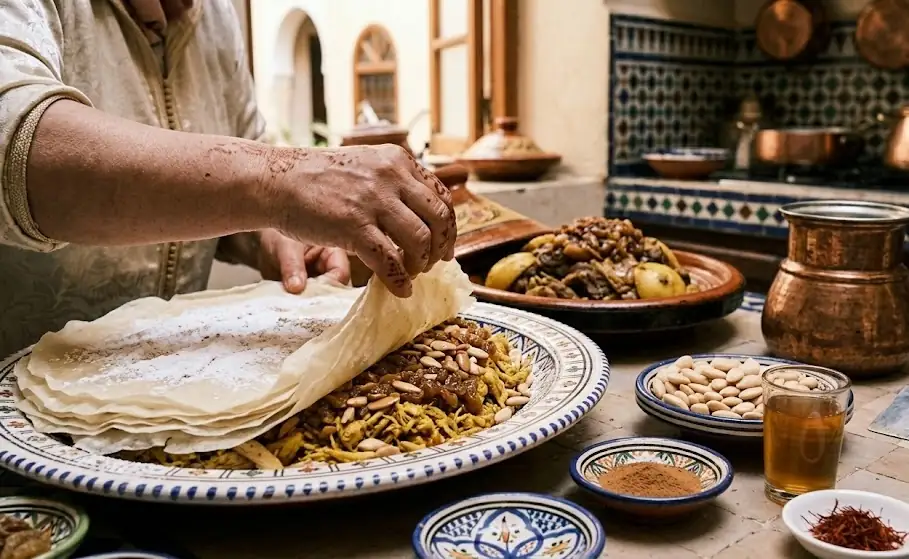
Friday in Morocco is a day organized around the couscous. Not around the prayer, though the prayer is there. Around the couscous. The prayer determines when the couscous is served — after the midday Jumu’ah — and the couscous determines what the morning looks like. You wake up, you buy vegetables at the market (the Friday market is more abundant than the rest of the week because everyone is buying for couscous), you begin the broth, you begin the first steam. By the time your family returns from the mosque, the kitchen smells like something that has been happening since before they left. The table is the reason to hurry home.
I am telling you this because it is important context for what follows, which is a fairly strong argument that instant couscous — the kind you pour boiling water over and cover for five minutes — is not couscous in the sense that the Friday couscous is couscous. It is a different product. Made from the same grain, processed in a completely different way, producing a completely different result. There is no shame in using it for a quick weeknight side dish. But calling it couscous the way a Moroccan means couscous is like calling a stock cube a broth.
What Is Couscous Made From and What Is the Correct Starting Grain?
Couscous is made from semolina — specifically, the coarsely ground endosperm of durum wheat, the same grain used for pasta but milled to a rougher texture that produces granules rather than a smooth flour. The semolina is moistened, then worked by hand to form very small irregular pellets, then dried. This is the raw couscous that goes into the couscoussier for steaming.
In Morocco, you can buy couscous at three grades: fine, medium, and coarse. Medium is what most home cooks use for the classic Friday preparation. Fine couscous is used for sweet preparations — the Seffa of Fes, steamed with milk and butter and dusted with cinnamon and powdered sugar. Coarse couscous is sometimes used for soups or for the thick couscous preparations of the Middle Atlas Amazigh tradition.
The instant couscous sold in supermarkets globally has been pre-steamed, then dried. The pre-steaming precooks the starch granules so that hot water rehydrates them in minutes. This convenience comes at a direct cost to texture: the pre-steaming collapses the granule structure partially, producing a softer, stickier result that lacks the springy, individual quality of properly triple-steamed fresh couscous. The flavors are also different because the Maillard browning reactions that develop during a long triple-steam over real broth don’t happen when you pour water over pre-processed grain.
What Is the Triple-Steam Technique and Why Does Every Stage Matter?
The traditional Moroccan couscous preparation involves steaming the grain three separate times, with a hand-working step between each steam that is as important as the steam itself.
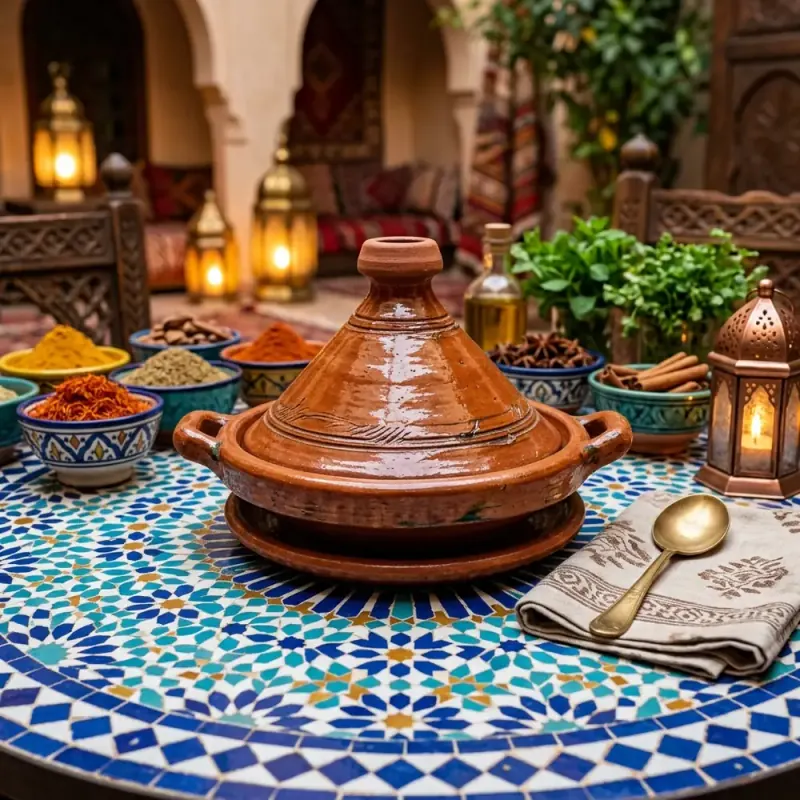
The couscoussier — the two-part steamer with a large pot below for the broth and a perforated colander on top for the couscous — is filled with water or broth below and the dry couscous goes into the top, loosely, without packing. First steam: 20-25 minutes over simmering liquid. When done, the couscous is tipped into a wide, flat-bottomed gsaa (the traditional wooden or earthenware couscous bowl) and worked vigorously by hand — both hands raking through the hot grain, pressing lumps, separating granules, aerating. Then cold water is sprinkled over it, a little at a time, while the working continues. A small amount of olive oil or butter is worked in.
This working step is what gives Moroccan couscous its characteristic texture: light, individual, with each granule separate from its neighbors. Skip it and your couscous comes out clumped. Work it for ten minutes and then return it, loosely, to the steamer.
Second steam: another 20 minutes. Then another working, this time with a light salting and more butter or smen worked through. The granules have softened further and expanded and the texture is noticeably different from after the first steam — more tender, more fully hydrated.
Third steam: 15-20 minutes over the now richly reduced broth. When tipped out for this final working, the couscous receives its final butter and a taste adjustment — does it need more salt? More warmth from the broth, spooned over? The broth is the seasoning agent, and this final addition is what integrates the grain with the flavor of everything that has been cooking below it.
What Goes Into the Broth and How Is the Traditional Couscous Composed?
The broth beneath the couscous is where the meal’s complexity lives. A meat couscous — the standard Friday preparation — begins with lamb or chicken pieces browned in Smen with onion, ginger, cinnamon, and saffron. Water or light stock covers it and it simmers for an hour minimum before the vegetables begin going in in sequence, each one timed for its own cooking duration.
The traditional seven-vegetable couscous — couscous aux sept légumes — is ceremonial in its composition: each of the seven vegetables is a specific choice, not arbitrary, and the number seven carries significance beyond the practical. In the Fassi tradition: turnip, carrot, courgette, cabbage, pumpkin or squash, tomato, and onion. The tomato and onion cook for the full duration; the courgette goes in for only the last twenty minutes or it will disintegrate. The turnip and carrot go in at the same time as the meat because they take the longest. These timings are not in a recipe. They are in the cook.
The finished couscous mound is built in the gsaa: the grain piled into a dome, the vegetables arranged around and over it, the meat pieces placed on top, and then the broth — deep, golden, spice-fragrant — ladled generously over the entire surface so it soaks downward through the grain, and a separate bowl of broth placed on the table for those who want more. The gsaa goes in the center of the table. Hands gather around it.
The Invisible Invitation
It is five past one on a Friday afternoon and the family is arriving through the front door in their Friday clothes, the children slightly louder than they were when they left for the prayer two hours ago. The couscoussier has been on since ten in the morning and the smell from the kitchen is so completely Friday that I could identify it in complete darkness. The gsaa is heavy — two kilograms of steamed grain, four kilograms of vegetables and lamb, half a liter of broth ladied over the top. We carry it together to the table. Everyone takes their place. There is no ceremony. There is just the bowl, and the bread, and the people around it, and the fact that this exact arrangement of these exact things has been the shape of Friday in this country for twelve centuries. Sit down. It’s ready.
SEO Meta Description: What is traditional Moroccan couscous and why does Friday matter? The triple-steam technique, couscoussier method, seven vegetables, and why instant couscous is an entirely different product.
Experience the true heart of Moroccan heritage through its traditions. Join us in preserving these ancestral rituals.
What People Are Saying
No comments yet. Be the first — we'd love to hear from you.
Khadija Tahiri
A Moroccan cultural writer dedicated to documenting the authentic voice, history, and heritage of the Kingdom. Writing from within — to share what truly makes Morocco extraordinary.
Our Mission →