The Moroccan Hammam: A Complete Guide to the Art of the Bath
The Moroccan Hammam: Where Steam, Stone, and Community Create Something Sacred
Every Thursday evening, my grandmother would announce it the same way: “Yallah, hammam!” And the entire household — aunts, cousins, my mother — would begin organizing: the brass kessa mitt, the block of beldi soap (Savon Beldi), the argan oil, the ghassoul clay, and a clean djellaba to wear home after. Thursday was the night before Friday prayer. The hammam was preparation for the sacred.
The Moroccan Hammam is not a spa. It is not a sauna. It is a deeply ingrained social institution — one part purification ritual, one part community gathering, one part ancestral wellness practice — that has survived unchanged for over a thousand years. And it remains, to this day, the most authentic Moroccan wellness experience you can have.
The Architecture of the Hammam
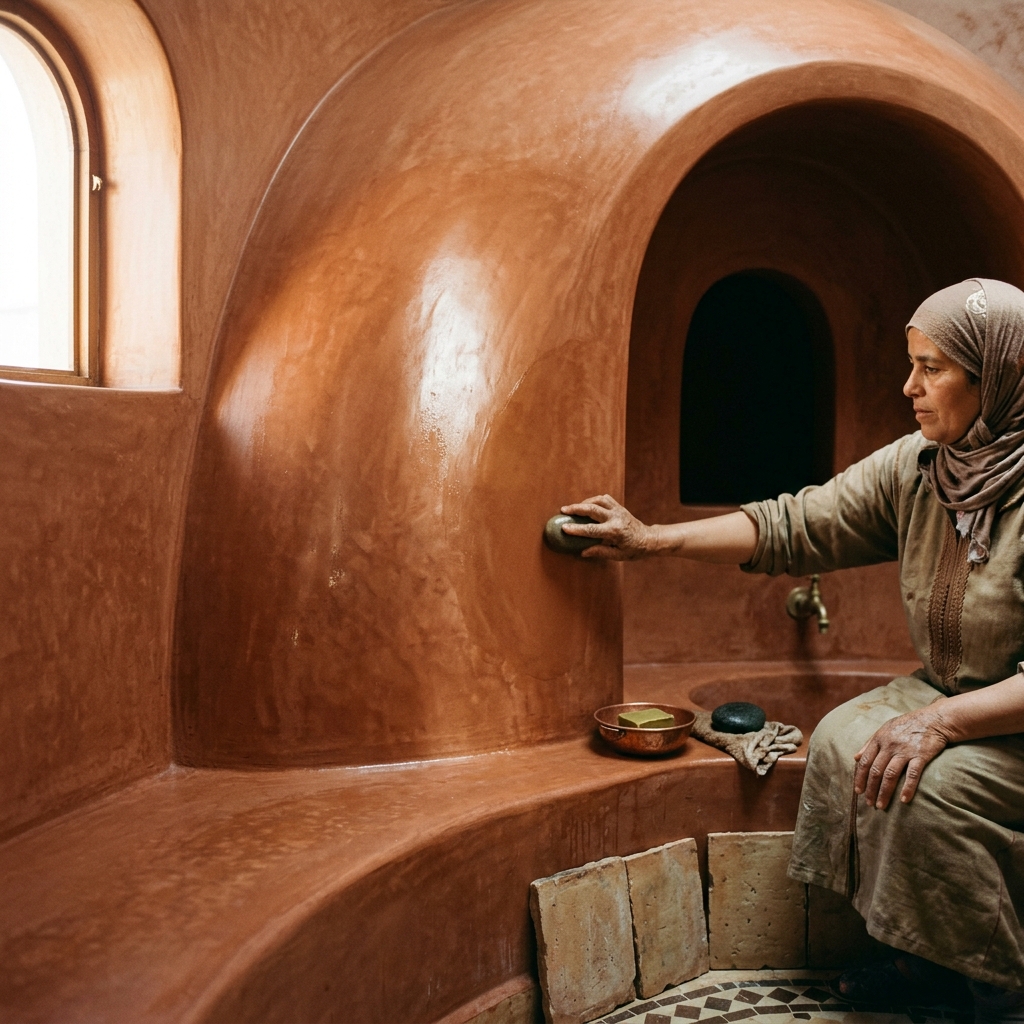
The traditional hammam beldi (local hammam, as opposed to a tourist hammam) follows a specific spatial logic developed over centuries:
- The Bard (Cool Room): The entrance and changing area, where you leave your clothes, receive your key for the locker, and transition between the outside world and the hammam world. Social conversations begin here.
- The Wastani (Warm Room): The intermediate temperature chamber, used for preparation and cool-down. This is where families gather, where mothers scrub children, where gossip is exchanged.
- The Sqoun (Hot Room): The innermost sanctum. The steam here is dense and ancient-smelling — mineral-rich water heated by a wood-burning furnace (Fsran) in the basement. This is where the serious scrubbing happens.
The Seven Steps of the Moroccan Hammam Ritual
If you attend a traditional hammam, here is what the process looks like:
1. The Steam Opening Arrive and find your spot on the marble bench. Close your eyes and let the steam penetrate your skin for 10-15 minutes. Your pores are opening. Your body is preparing.
2. The Savon Beldi Application The traditional soap (Savon Beldi) is a dark, almost black, paste made from olive oil and macerated olives. It has a specific, fermented, slightly earthy smell that I find deeply comforting. Apply it liberally all over your body and let it sit for 5 minutes.
3. The Kessa Scrub The Kessa — a rough, woven mitt — is the true instrument of the hammam. In a proper scrub, the dead skin accumulates into long grey rolls that fall away from the body. It is visually alarming the first time. It is liberating every time after.
4. The Ghassoul Mask Ghassoul is a volcanic clay mineral found only in the Atlas Mountains of Morocco. When mixed with rose water, it forms a mineral-rich paste that is applied to the hair, face, and body. It is one of the most effective natural cleansers known to humanity.
5. The Rinse Cold water, poured in large copper or plastic buckets (Tsa). It seals the pores. It is shocking and exhilarating.
6. The Argan Oil Finish Stepping out of the hot room, the skin is applied with pure argan oil while still slightly warm. The oil absorbs immediately into the open pores. Your skin will not feel this smooth again for a week.
7. The Rest Wrap yourself in a large towel, lie on the bench in the cool room, and simply… rest. Many Moroccans fall into a light sleep here. The combination of heat, cleansing, and physical work creates a profound relaxation. No one rushes you.
The Social Dimension: Why the Hammam Matters
The hammam is one of the few spaces in traditional Moroccan society where people from different social classes meet as equals — everyone stripped of their clothes and their status, sweating together on the same marble bench.
For women, in particular, the hammam has historically been a space of autonomy — a gathering place outside the home where information was shared, marriages were arranged, and friendships were maintained. The Thursday hammam was, for centuries, the primary social outlet for many Moroccan women.
This is why the hammam is not just about hygiene. It is about belonging.
The Oldest Wellness Ritual in Morocco
The world has discovered “wellness tourism” as if it were a new idea. In Morocco, we have had it for 1,200 years. The hammam is not a trend. It is a pillar. Come experience it not as a tourist attraction, but as a participant in a living tradition. Don’t forget your kessa mitt!
Frequently Asked Questions (FAQ)
Q1: Is it appropriate for non-Muslims or foreigners to use a traditional hammam? A: Absolutely. Traditional hammams in Morocco welcome everyone. You will receive a warm (quite literally) welcome. Some basic knowledge of the ritual process helps, but staff are usually happy to guide first-timers.
Q2: What is the difference between a “hammam beldi” and a luxury spa hammam? A: A hammam beldi is a local, neighborhood hammam — typically costing between 10-30 MAD (€1-3) and following the traditional multi-room structure. A luxury “hammam” in a hotel or spa uses the same products and techniques but in a private setting, usually for a single person rather than a communal experience. Both are valid; only the social dimension differs.
Q3: What should I bring to a Moroccan hammam? A: At minimum: a kessa mitt, savon beldi, ghassoul clay, and a large towel. Most hammams sell these products at the entrance. Flip-flops are strongly recommended for hygiene on the warm stone floors.
Experience the true heart of Moroccan heritage through its traditions. Join us in preserving these ancestral rituals.
What People Are Saying
No comments yet. Be the first — we'd love to hear from you.
Khadija Tahiri
A Moroccan cultural writer dedicated to documenting the authentic voice, history, and heritage of the Kingdom. Writing from within — to share what truly makes Morocco extraordinary.
Our Mission →