Henna: The Sacred Language Written on Moroccan Women's Hands
Henna in Morocco: The Symbols, the Ceremony, and What Nobody Ever Explains to Outsiders
I’ll start with something that bothers me about how Moroccan henna is usually described to people from outside our culture: it is almost always presented as decorative. As body art. As something aesthetic.
And it is beautiful, yes. But that framing misses everything that actually matters about it.
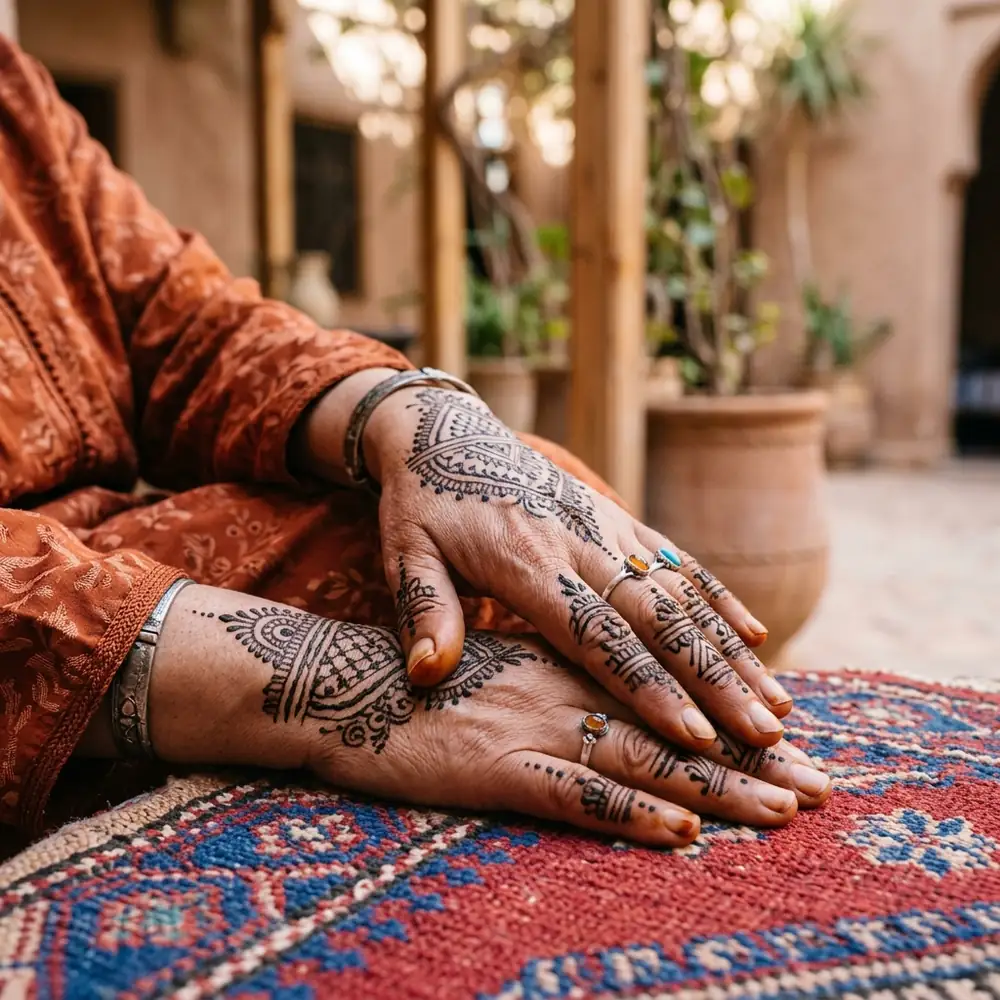
Henna — or more precisely khidab in Moroccan Darija — is a writing system. Every motif that a nqasha (a henna artist) draws on a bride’s hand is a statement. A prayer, sometimes. A protection, sometimes. A claim about who this woman is and what her family wishes for her life. The bride cannot see most of it as it goes on — her hands are turned palm-up and she has to hold still — but everyone else in the room can read it. The older women especially.
What Do Traditional Moroccan Henna Symbols Actually Mean?
The vocabulary of Moroccan henna design is enormous and varies considerably by region — what a henna artist in Fes does is distinctly different from what you’ll see in Agadir or in the Rif Mountains — but a few motifs appear across the entire country with consistent meaning.
The khamsa — the open hand with five fingers, often rendered in incredibly fine geometric detail — is the single most powerful protective symbol in our culture. Five fingers. Five because it deflects the five senses of anyone whose gaze might carry envy or harm. You see it on the doors of houses, worked into the brass of door knockers, tattooed in faded blue-green on the wrists of older Berber women in the Atlas. On a bride’s hand, on her wedding night, it is both beautiful and absolutely serious.
The crescent and star appear frequently on the inner wrist — a reference to the Islamic divine, yes, but also something older: a marking of cyclical time, of the moon’s rhythm that governs fertility and harvest, that our grandmothers observed long before it became a symbol on a flag.
The lozenge — a diamond shape, often interlocked in chains across the backs of hands — represents the female body specifically: the pelvis, the capacity to carry life forward. You won’t find this explained in most tourist descriptions of Moroccan henna. But any woman who applies it knows exactly what she’s drawing.
How Is Genuine Moroccan Henna Paste Made?
What’s sold in the tourist markets as “henna paste” is often not. Real khidab is green-black, slightly grainy, and smells strongly of plant matter — similar to strong green tea with a vegetal bitterness underneath.
Authentic henna paste starts with the dried, powdered leaves of Lawsonia inermis — a shrub that grows across North Africa and the Arabian Peninsula. The powder is mixed with very strong black tea (never water, the tannins matter), the juice of half a lemon, and two or three drops of clove essential oil. The clove serves a real function: it helps the lawsone molecule — the pigment — penetrate more deeply into the skin’s keratin layer.
The paste needs to rest for at least twelve hours before application, sealed airtight. During this time, the lawsone releases from the plant cells and concentrates in the liquid. This is why fresh henna stains darker than paste used immediately after mixing. Our grandmothers prepared it the night before and left it wrapped in cloth.
A nqasha applies it from a cone of wax paper — rolled by hand, the tip cut to a precise fineness — and the design is drawn freehand. No stencils. No tracing. The speed and steadiness of a practiced hand is something genuinely remarkable to watch: the cone moving over the skin without hesitation, turning complex geometric patterns with total confidence.
What Happens During the Laylat al-Henna Ceremony?
The Laylat al-Henna — the Night of Henna, held the evening before a wedding — is one of the most important events in a Moroccan woman’s life, and it is almost entirely invisible to anyone outside the family.
No men attend. That’s the first thing to understand. This is a space that belongs entirely to the women of the bride’s family and her close friends — the mother, the aunts, the grandmothers, the childhood friends she grew up with in the neighborhood. It is, underneath the singing and the celebration, a preparation: the older women transferring their knowledge of married life to the younger one, through stories and through the collective act of surrounding her with beauty.
The bride’s mother has henna applied first. This is non-negotiable. She is the origin of the celebration; the design on her hands blesses everything that comes after. Then the bride’s hands and feet receive the most elaborate work the nqasha is capable of — sometimes requiring four to five hours of continuous application. The bride must keep her hands absolutely still throughout.
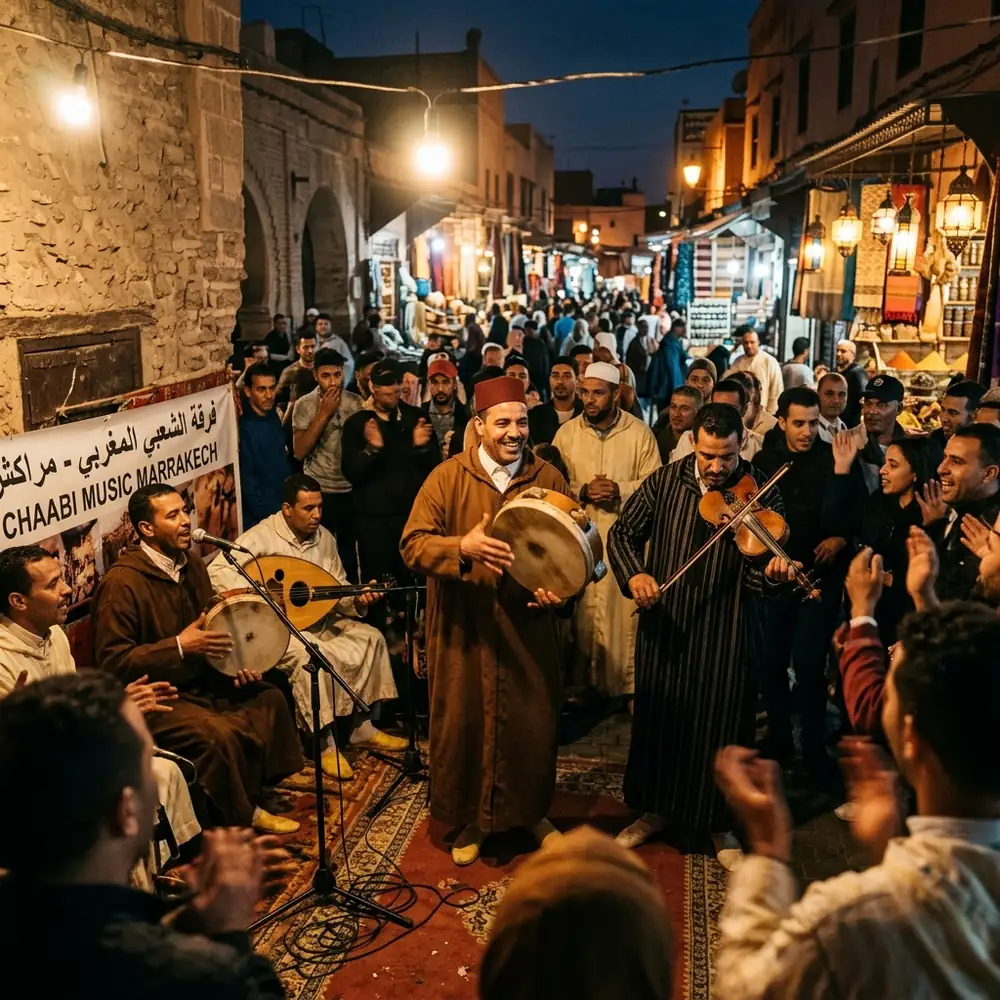
While this happens, the women sing. Traditional wedding songs in Darija and sometimes in Amazigh, songs that most of them learned from their own mothers, songs that exist nowhere in written form and are transmitted entirely through memory and repetition.
The Invisible Invitation
The room smells of fresh henna and orange blossom water and the incense burning in a terracotta mijmar in the corner. The bride has been sitting for two hours and her hands are covered in drying paste the color of dark mud. Her youngest cousin, maybe seven years old, is asleep in the corner on a pile of embroidered cushions. The nqasha is working on the left palm now, her cone moving steadily. Someone is singing something slow and repetitive in the next room. Pull up a cushion. You don’t need to understand the words.
SEO Meta Description: What do Moroccan henna symbols mean? A local guide to the Khamsa, the Laylat al-Henna ceremony, and the ancestral art of khidab paste on brides’ hands.
Experience the true heart of Moroccan heritage through its traditions. Join us in preserving these ancestral rituals.
What People Are Saying
No comments yet. Be the first — we'd love to hear from you.
Youssef Amazigh
A Moroccan cultural writer dedicated to documenting the authentic voice, history, and heritage of the Kingdom. Writing from within — to share what truly makes Morocco extraordinary.
Our Mission →