Mrouzia: The Aid el-Adha Lamb Tagine With Honey, Ras el Hanout, and Almonds That Keeps for a Month
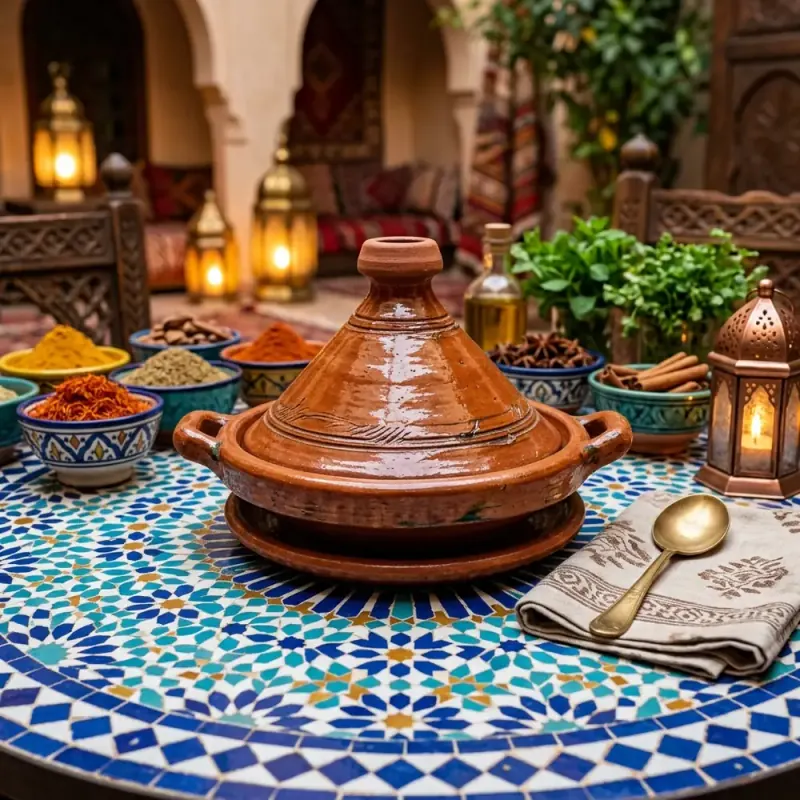
Mrouzia: The Tagine Designed to Last a Month and the Specific Week It Is Made
Mrouzia is made once a year. This is not a cultural preference or a recipe difficulty — it is because mrouzia is specifically designed for Aid el-Adha, the Feast of the Sacrifice, when every family that can afford to sacrifices a sheep and is suddenly in possession of more fresh lamb than a household can eat in a few days. The response to this seasonal abundance of meat is a preservation strategy: cook some of the lamb in a preparation that, by virtue of its high honey content, its deep reduction, and its spice environment, will remain edible at room temperature for two to four weeks.
The honey is not incidental to mrouzia’s flavor. It is the preservation mechanism. High sugar concentration inhibits the microbial growth that causes meat to spoil — the same principle that preserves jam, that makes candy shelf-stable, that kept the Moroccan trade caravans’ provisions edible across weeks of desert travel. A lamb tagine cooked down to a confited consistency in sufficient honey will not spoil at room temperature for the duration of the Aid period and beyond. This is why mrouzia is sweet enough to surprise people encountering it for the first time: not because Moroccan cooks wanted a dessert with meat, but because they needed a preservation method that the available ingredients could provide.
What Are the Specific Spices in Mrouzia and How Does Ras el Hanout Function?
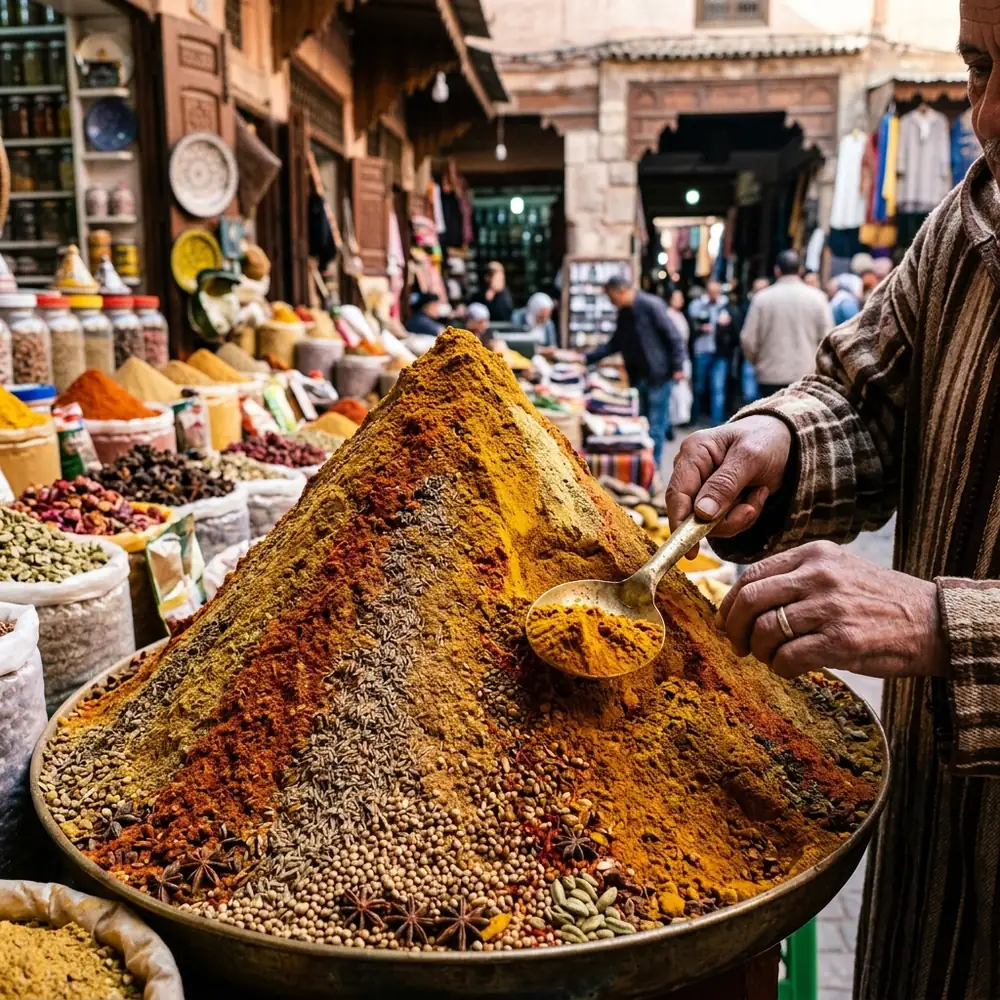
Mrouzia’s spice profile is organized around ras el hanout — the complex Moroccan spice blend that in its most complete form contains twenty or more individual spices — plus additional cinnamon and a significant amount of ground ginger. The ras el hanout in mrouzia functions differently from how it functions in a simple tagine: the long cooking time and the reduction of the sauce to a near-syrup concentrates the spice flavors to a depth that shorter preparations cannot achieve.
The specific ras el hanout used for mrouzia in traditional Fassi households is the most complex version available — a full-spice blend including rose petals, cubeb pepper, mace, orris root, and other elements that simpler blends omit. The complexity of the spice base is appropriate to a dish that will be eating itself over weeks, developing as it sits, the spices continuing to meld and deepen in the sauce even off the heat.
For households that make their own ras el hanout or that have access to a good spice market: buy the blend specifically identified for mrouzia, which the Fes and Marrakech spice vendors stock seasonally in the week before Aid. It is not the same as the everyday cooking ras el hanout.
What Is the Cooking Process and How Long Does It Take?
The lamb — bone-in shoulder pieces from the Aid sacrifice, cut into large sections — is rubbed with a mixture of smen, ras el hanout, ginger, cinnamon, salt, and a pinch of saffron and left to marinate overnight. The next day, the pieces go into a large, heavy pot with the marinade, a significant amount of caramelized onion (cooked separately until very soft and golden), and enough water to come halfway up the meat. This cooks, covered, over low heat for approximately two hours.
When the lamb is fully tender and the sauce has reduced substantially, the honey goes in — a very generous amount, several hundred grams for a pot serving six to eight, enough that the sauce becomes distinctly sweet and thick. The fried almonds and plumped raisins follow. The pot continues cooking, uncovered now, over medium-low heat, stirring occasionally, for another thirty to forty-five minutes until the sauce has reduced to a thick, glossy, almost confited consistency — not liquid anymore but a coating paste that clings to the lamb pieces.
This final reduction is the most critical stage. Too much remaining liquid and the mrouzia won’t keep; too aggressive a reduction and the honey scorches, producing bitterness. The target consistency is when a wooden spoon dragged through the sauce leaves a trail that closes slowly over five seconds and when the surface, when the pot is tilted, moves as a single slow body rather than flowing freely.
How Is Mrouzia Stored and How Is It Eaten Over the Following Weeks?
The finished mrouzia, cooled to room temperature, is stored in a sealed ceramic or glass vessel — the traditional container is a glazed terracotta jar with a fitted lid. At room temperature in the Moroccan autumn or winter conditions (the Aid’s timing means the climate is cooling), it keeps for two to four weeks without refrigeration, the honey’s preservation properties maintaining the meat’s safety.
Each time mrouzia is served from the jar, the surface is pressed back down to eliminate air contact, and the vessel is resealed. The flavor develops and deepens over the storage period — a two-week-old mrouzia is more complex than a three-day-old one, the spices having melded further and the honey having permeated the meat more completely.
At serving: mrouzia is eaten at room temperature or slightly warmed, with bread. It is a rich, intensely flavored, sweet-savory preparation that is typically served in small portions as part of a larger spread rather than as a main dish in the quantities that a tagine commands. Two or three pieces of lamb with the thick sauce on a small plate, with khobz for scooping — this is the correct serving format.
The Invisible Invitation
It is the second morning after Aid. The mrouzia is in its jar, made yesterday, sealed last night. The house still smells of the cooking — the ras el hanout, the honey reduction, the fried almond from the finishing stage. Open the jar. The smell that comes out is concentrated and warm and entirely specific to this preparation — sweet and spiced and deep in a way that nothing else in the Moroccan kitchen produces exactly. Take two pieces of lamb. The sauce clings to them in thick coats. Eat them with bread, at room temperature, as breakfast on a cold morning two days after Aid. This is the dish doing exactly what it was designed to do: providing the lamb of the sacrifice in a form that is still at its best a week after the sacrifice. It will be better in another week. It will still be good in two. The design was correct.
SEO Meta Description: How to make Moroccan mrouzia tagine for Aid el-Adha? The honey preservation mechanism, ras el hanout blend selection, reduction technique, and how to store and serve over the following weeks.
Experience the true heart of Moroccan heritage through its traditions. Join us in preserving these ancestral rituals.
What People Are Saying
No comments yet. Be the first — we'd love to hear from you.
Khadija Tahiri
A Moroccan cultural writer dedicated to documenting the authentic voice, history, and heritage of the Kingdom. Writing from within — to share what truly makes Morocco extraordinary.
Our Mission →