The Attarine Madrasa: The Spice Market Madrasa of Fes and Reading Its Carved Walls
The Attarine Madrasa: How to Read a Carved Wall in Fes
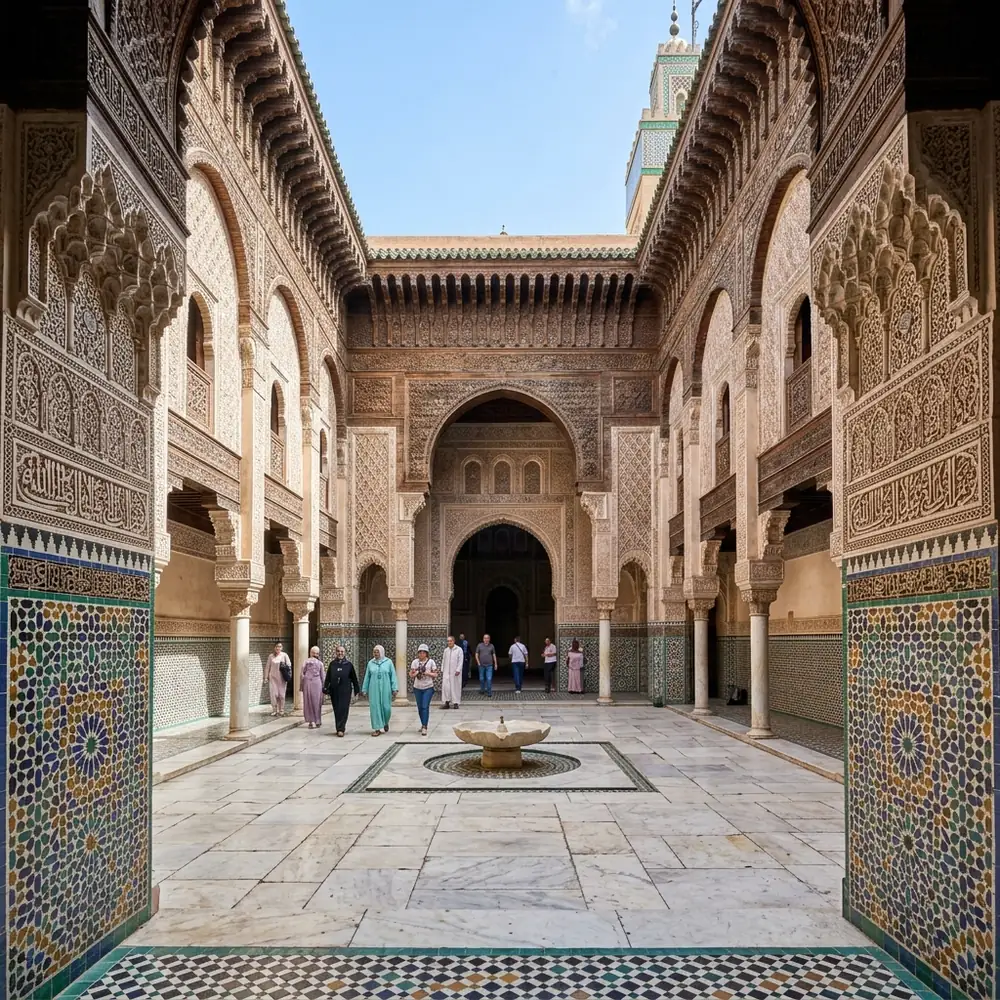
The Attarine madrasa in Fes is often treated as a warm-up for the Bou Inania — the smaller, earlier madrasa that you visit before the more famous one — and this is a mistake I want to correct. The Attarine is not lesser than the Bou Inania. It is different: smaller, more intimate, its decoration at a scale that allows detailed examination more readily than the Bou Inania’s larger surfaces, and its position directly adjacent to the Qarawiyyin mosque giving it a contextual significance that the Bou Inania, positioned farther from the mosque on the commercial Talaa Kebira, doesn’t have in the same way.
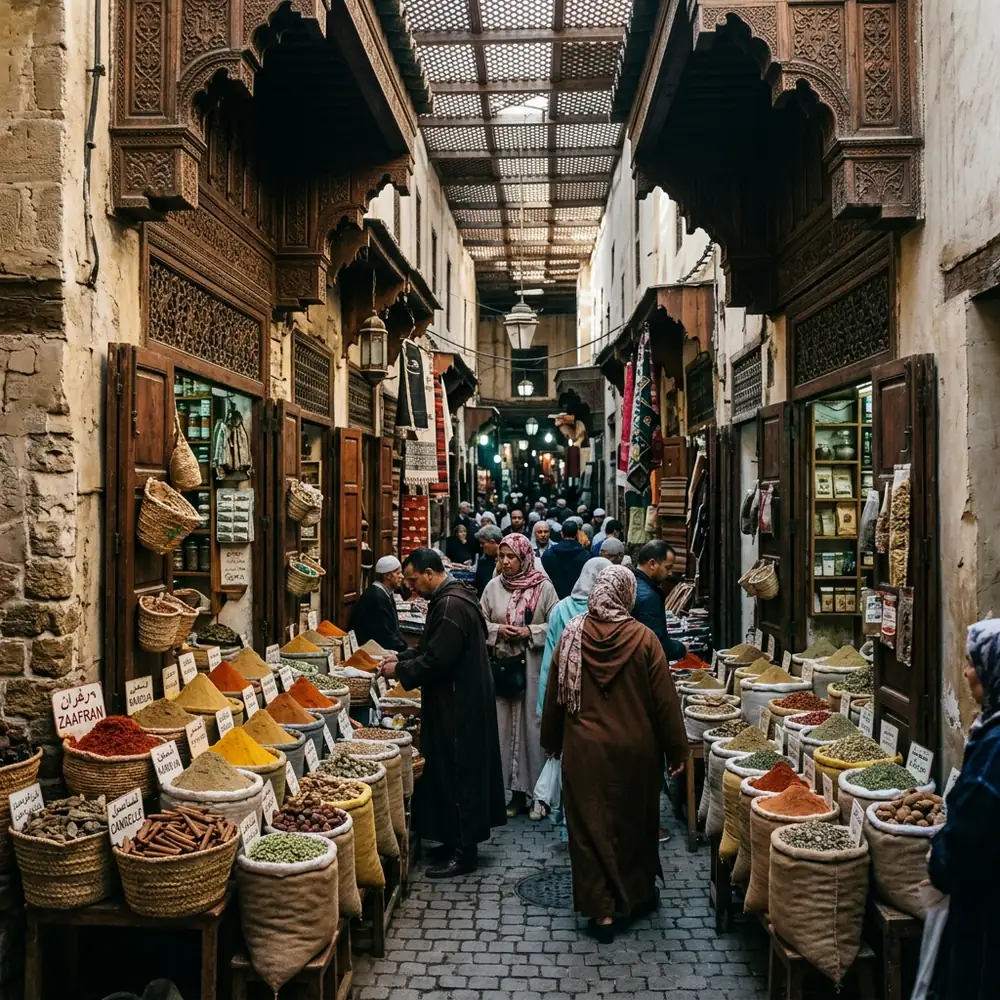
The madrasa was built by the Merinid Sultan Abu Said in the early 14th century — approximately forty years before the Bou Inania — as a student residence serving the Qarawiyyin mosque-university. Its name derives from the souk el-attarine (spice market) immediately adjacent to the madrasa’s main entrance: the smell of cumin and ras el hanout and dried herbs from the spice market has been present at the Attarine’s entrance for seven hundred years and is still present today.
What Is the Attarine’s Courtyard and What Should You Look At?
The Attarine’s courtyard is smaller than the Bou Inania’s — perhaps eight by ten meters — which means that the decorative surfaces are closer to the viewer and more immediately readable at human scale. The same three-zone vocabulary applies: zellige at the base, carved plaster in the middle, carved cedar above. But the proportion of the courtyard to the viewer’s body is different, and the decorative program is visible as an integrated whole rather than requiring the viewer to move around the space to take it in section by section.
Stand at the center of the courtyard beside the small pool. Look at the carved plaster panel directly ahead of you — the panel between the zellige base and the cedar gallery above, in the primary field of view. This is the panel to begin with.
How to Read the Geometric System in Moroccan Carved Plaster
Every carved plaster panel in every traditional Moroccan madrasa is generated from a single geometric figure — typically an eight-pointed star, a twelve-pointed star, or a six-pointed star — repeated, rotated, interlocked, and extended to fill the entire panel surface. The complexity that makes these panels appear overwhelming on first encounter is the result of many repetitions and extensions of a simple originating form, not of many different forms assembled together.
Finding the originating form in a panel takes a few minutes and requires looking at the panel’s overall structure rather than at its local detail. Here is how to do it at the Attarine:
Look at the carved plaster panel in the main courtyard wall. Don’t look at the fine carved detail — look at the large-scale pattern. Identify the largest repeated figure in the composition. It will be either a star or a polygon. Count its points or sides. In the Attarine’s main courtyard panels, the originating figure is a twelve-pointed star — twelve points radiating from a central hexagonal form.
Once you see the twelve-pointed star — and once you see it, it becomes impossible not to see it — trace how the star’s points connect to adjacent stars and how the spaces between the stars are filled. The spaces are filled with smaller geometric figures that are themselves subsets of the same star’s geometry. The entire panel is one geometric system at multiple scales.
This is the principle of Islamic geometric pattern: a single generating figure producing all the complexity through repetition, rotation, and extension. The Attarine’s panels are a beautiful and accessible introduction to this principle because their scale allows close examination and the generating figure is not overly complex.
What Is the Cedar Carving Above the Plaster and What Does It Do?
The carved and painted cedar that covers the upper portion of the courtyard walls — the gallery level above the carved plaster — serves a different function from the plaster below it: where the plaster is dense and surface-covering, the cedar is structural and creates depth through the lattice-and-void structure of the moucharabieh screens.
The cedar in the Attarine was painted in the original construction with the zouak decoration — polychrome geometric and floral patterns applied to the carved cedar surface in red, black, blue, and green mineral pigments. The original colors are substantially faded — seven hundred years of light and humidity in the courtyard environment — but the pattern is still readable and the traces of the original color palette are visible in the protected sections. In the best-preserved areas, the zouak painting shows a color and a density that, at full original saturation, must have made the courtyard extraordinary beyond its current already-extraordinary state.
The cedar also contains the inscriptive program of the madrasa: Quranic verses and the names of the building’s patron carved into friezes at the transition between the plaster and cedar zones, where calligraphy serves simultaneously as decoration and as textual communication with those literate enough to read it. The inscriptions in the Attarine’s cedar zone have been documented and translated; they are available in the site’s published materials and are worth reading separately from the physical experience of the building.
The Invisible Invitation
You have found the twelve-pointed star in the main courtyard panel. You can see it now, and you can see how it generates all the surrounding pattern through its extension. Spend five more minutes following the pattern’s logic outward from that star — find the next star, trace how the connecting lines work, identify the subsidiary figures in the spaces between. By the end of five minutes, you will be able to read the panel as a whole rather than as a complexity. The complexity was always organization. The organization was always present. You just needed to find the entry point, which is the star, which is what every Moroccan geometric pattern gives you if you look for it. Take this knowledge to the Bou Inania. The entry point is the same. The panel is larger and the star may be different in its number of points. The principle is identical.
SEO Meta Description: What is the Attarine madrasa in Fes? The Merinid spice market school — how to read Islamic geometric pattern from the 12-pointed star, zouak cedar painting, and why it’s different from Bou Inania.
Experience the true heart of Moroccan heritage through its traditions. Join us in preserving these ancestral rituals.
What People Are Saying
No comments yet. Be the first — we'd love to hear from you.
Omar Idrissi
A Moroccan cultural writer dedicated to documenting the authentic voice, history, and heritage of the Kingdom. Writing from within — to share what truly makes Morocco extraordinary.
Our Mission →