Zaalouk: The Moroccan Eggplant Salad Where the Flame Step Is Not Optional
Zaalouk: What the Flame Does to an Eggplant and Why Nothing Else Does It
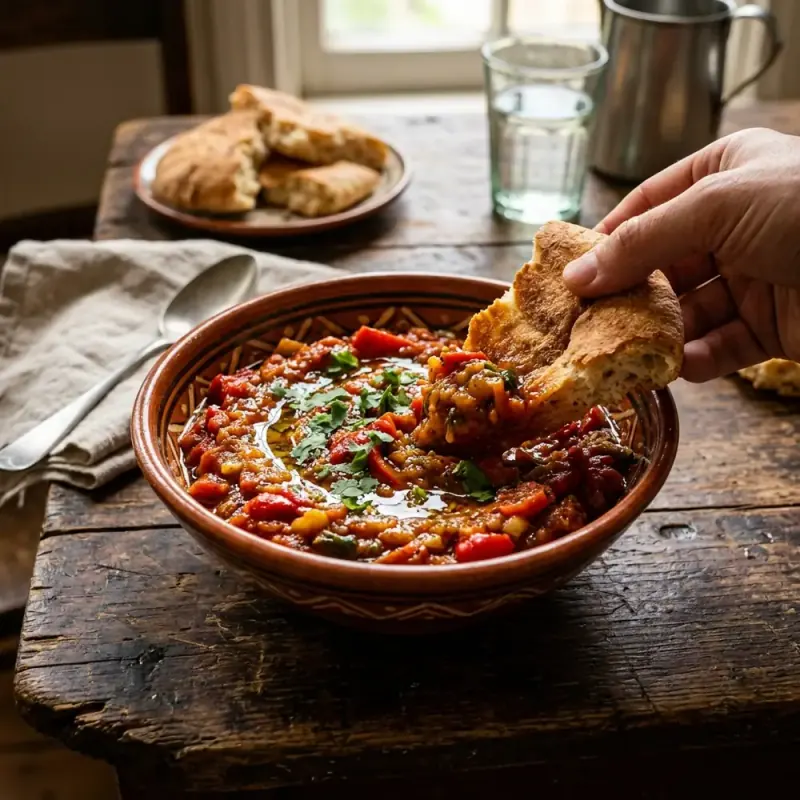
Zaalouk is often described as “Moroccan smoky eggplant dip” in international food writing, which gets the smoke right but misses the dish in two ways: it is not a dip in any cultural sense, and describing it as simply “smoky” doesn’t capture what charring an eggplant over a direct flame actually does to the interior of the vegetable.
Let me describe what happens when an eggplant is placed directly on a gas burner flame or live charcoal and left there, rotating occasionally, until the exterior is completely charred — not browned, completely charred, black and collapsing — and the interior is fully cooked. The smoke from the burning exterior skin penetrates the flesh. The high, direct heat cooks the interior more rapidly than oven heat does, producing a characteristic collapse of the flesh into soft, silky threads rather than the firmer texture of oven-roasted eggplant. The char flavor — not bitter, not unpleasant, a specific woodsy depth — saturates the eggplant’s flesh from the inside as the smoke is trapped between the collapsing interior and the sealed char exterior.
When you peel away the charred skin and the flesh emerges — steaming, collapsing in your hands, smelling intensely of smoke and eggplant simultaneously — it is a different thing from what went over the flame. The oven produces a roasted eggplant. The flame produces a charred eggplant. They are not the same thing and they produce different zaalouk.
What Is the Full Zaalouk Method?
Char the eggplants. For a preparation serving four as one of several salads, two medium eggplants. Place them directly on a gas burner at high heat, or over charcoal if you are fortunate enough to be cooking outdoors. Rotate with tongs as each section chars — the skin should blacken completely, the eggplant should be collapsing and soft when pressed. Total time over the flame: ten to fifteen minutes depending on size. The eggplant is done when a knife inserted at the thickest part meets no resistance.
Transfer to a colander and let them drain as they cool — there is a significant amount of bitter liquid released as charred eggplant cools, and allowing it to drain away produces a less bitter, more concentrated final flavor. Peel when cool enough to handle, removing all char and as much seed-dense interior as possible. The resulting pale, soft, smoky eggplant flesh goes onto a cutting board and is chopped coarsely — not mashed, chopped, so that the final zaalouk has some texture.
In a pan, warm olive oil — generous, three tablespoons — with three cloves of garlic, sliced, until the garlic is beginning to turn golden. Add two grated fresh tomatoes (or half a tin of crushed tomatoes), cumin — one teaspoon — sweet paprika, a pinch of hot paprika, salt. Cook the tomato base for ten minutes until thick and reduced. Add the chopped eggplant. Stir everything together and continue cooking for another ten to fifteen minutes until the eggplant and tomato have integrated completely — no distinct pools of liquid, no separating oil, just a unified, dense preparation that holds its shape when spooned.
Fresh flat-leaf parsley, chopped, and a squeeze of lemon at the end. Drizzle additional olive oil over the surface when serving.
What Is the Correct Texture and How Do You Know When It Is Ready?
The zaalouk is ready when a spoon dragged through the preparation leaves a trail that closes slowly. It should be thick enough to hold on a piece of bread without sliding off, not so thick that it is a paste. The oil, which initially appears separate on the surface, should have been worked into the preparation through the cooking process — not absorbed entirely but integrated so that no pool of oil sits separately on the surface.
If the zaalouk seems too wet after fifteen minutes of cooking with the eggplant, uncover and cook at higher heat for five additional minutes, stirring constantly. If it seems too dry — which happens if the eggplant was very watery — add a small splash of water and stir to incorporate.
The zaalouk can be served warm, at room temperature, or cold, and like most cooked salads it is better at room temperature than hot or refrigerator-cold. Make it in the morning for a lunch or early afternoon meal; it improves in the hour of resting.
What Is Zaalouk Served With and Where Does It Appear in the Meal?
Zaalouk is a cooked salad — salada matboucha in the general category — and appears with the other cooked salads (carrot, taktouka, cooked lentil salad, beet salad, depending on the household and region) at the beginning of a Moroccan meal, before the tagine or couscous. It is not a side dish in the Western sense and it is not served alongside the main dish. It is the beginning of the meal, eaten with bread while the tagine is still on the fire.
Outside the formal meal context, zaalouk appears as a spread for bread at breakfast in households that make it in quantity and keep it through the week, and it is one of the better things to put on a khobz at any time of day.
The flavor pairs particularly well with strong cheeses — the smoke and garlic and eggplant meeting hard, aged cheeses from the Atlantic coast — but this is a combination I have encountered more in my kitchen than in traditional Moroccan food contexts.
The Invisible Invitation
The eggplant is on the flame and the kitchen smells like a campfire for ten minutes, which will alarm anyone who doesn’t know what you are doing and will be completely correct to anyone who does. The char is complete when the whole eggplant is collapsed and the skin is uniformly black — not black in patches, uniformly black. Pull it off the flame and put it in the colander over the sink. The liquid that drains from it is dark and bitter and is the thing being removed to make the zaalouk better. Give it fifteen minutes. The eggplant will have cooled to workable temperature. Now peel it. The char comes away in sections, sometimes with steam still rising from the flesh underneath. What you are holding is nothing like what went over the flame. This is the point. Start cooking the tomatoes. The zaalouk will be ready in twenty minutes.
SEO Meta Description: How to make Moroccan zaalouk eggplant salad? The direct-flame charring method, tomato-spice integration, correct texture, and why oven roasting produces a different dish.
Experience the true heart of Moroccan heritage through its traditions. Join us in preserving these ancestral rituals.
What People Are Saying
No comments yet. Be the first — we'd love to hear from you.
Khadija Tahiri
A Moroccan cultural writer dedicated to documenting the authentic voice, history, and heritage of the Kingdom. Writing from within — to share what truly makes Morocco extraordinary.
Our Mission →