Zellige: The Living Mathematics of Moroccan Tilework
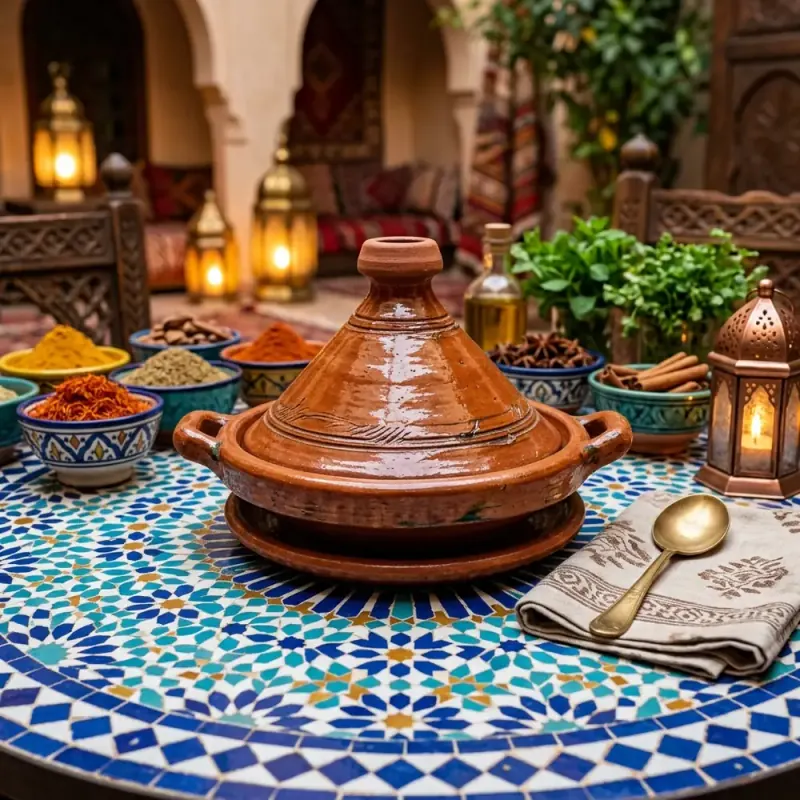
Zellige: What Makes Moroccan Tilework One of the Most Technically Demanding Art Forms Alive Today
I want you to crouch down for a second. Wherever you’re reading this — crouch, or just imagine crouching — and look at the floor of any courtyard in any palace in Fes or Marrakech. Look at it like you’re actually seeing it for the first time.
Count the pieces. I’ll wait.
It’s impossible, of course. The number of individual hand-cut tiles in the floor of the Bahia Palace courtyard alone is somewhere in the hundreds of thousands. Each piece a different geometric shape, each one chipped from a flat glazed ceramic slab by a craftsman with a pointed hammer and twelve years of learning how not to crack it wrong. No two pieces are interchangeable. The entire thing is a single, irreplaceable, non-repeating composition the size of a football pitch.
This is Zellige. And once you actually understand how it’s made, the fact that it exists at all starts to feel a little miraculous.
How Is Traditional Moroccan Zellige Actually Made?
The process begins in the clay workshops of Fes — specifically the Ain Nokbi district, which has been producing Zellige tile since the 10th century and has not fundamentally changed what it does in the intervening thousand years.
Raw clay is wedged, shaped into flat slabs about two centimeters thick, and fired once in a wood-burning kiln to create the bisque. The glaze — and here’s where the color lives — is made from metallic oxides that react differently to heat: cobalt carbonate gives you that deep royal blue that you see everywhere in Fes; copper oxide produces the cool seafoam green; manganese gives black; antimony or lead gives yellow; tin oxide gives white; iron oxide in different concentrations gives everything from honey amber to blood orange.
The glaze is applied by hand to one face of the slab only, then the piece is fired again. When it comes out, the glaze is fused, permanent, smooth as glass on top and raw terracotta on the bottom.
Now comes the part that separates Zellige from every other decorative tile tradition in the world.
A Mâalem — a master craftsman — sits cross-legged on the floor, a flat anvil stone between his knees, and begins to cut. His tool is a menqach: a short-handled hammer with a hardened steel blade on one end. He places the slab face-down on the stone, positions the blade against the reverse side at a precise angle he calculates entirely through accumulated instinct, and strikes. A triangle comes free. Then another. Then a five-pointed star shape, then a slender elongated diamond, then a hexagon with two concave sides. Each piece destined for a specific position in the pattern.
And there is no paper template under his hands. No projected guide on the stone. He is working from a geometric pattern he holds entirely in his mind — a pattern he has been building piece by piece for twenty years.
What Do the Colors of Zellige Actually Mean?
This is something that most visitors don’t think to ask, and I think it matters.
In the traditional chromatic vocabulary of Moroccan Islamic art, color carries theological weight. Blue — the deep ultramarine cobalt blue that you see dominating the tilework of Fes’s great monuments — represents divine infinity and the heavens. It is the color that points upward, toward what cannot be contained. White represents the sacred negative space between forms: the silence in the prayer, the emptiness that makes the pattern readable. Green, in the Islamic tradition, is the color of the Prophet and of paradise. It is used sparingly, with deliberateness.
Terracotta — the red-orange of unglazed clay — represents the earth itself. Our earth. The Atlas. The Saharan south. It is used in the border bands and transition zones of compositions, anchoring the celestial blues to something mortal and rooted.
And black, in the intricate star patterns, defines the geometry. Without black, the pattern disappears into noise.
Why Do Mathematicians Study Zellige Patterns?
Because they found something in them that shouldn’t have been there.
In 2007, physicists Peter Lu and Paul Steinhardt published a paper in Science demonstrating that complex Islamic geometric tilework patterns from as early as the 13th century — including patterns found in Moroccan Zellige — were encoding what mathematicians call “quasi-crystalline geometry.” A non-repeating, mathematically complex tiling structure that Western science didn’t formally describe until Roger Penrose published his work on it in 1974.
Our craftsmen were building Penrose-tiling patterns by hand, guided by pure geometric intuition developed over generations of practice, six centuries before the mathematical framework existed to describe what they were doing.
I find this deeply satisfying. Not because it validates our tradition through Western science — it doesn’t need that validation. But because it suggests that the Mâalem and the mathematician are, underneath everything, asking the same question.
The Invisible Invitation
The workshop smells of wet clay and wood smoke. The Mâalem is working on a commission for a private riad renovation — he’s been at it since seven in the morning and it’s now past three in the afternoon. He hasn’t looked up. The pieces accumulate on the flat stone around him: a constellation of blue stars, white hexagons, black border lines, coming slowly together into a face that is recognizable as a pattern only from a distance. He chips another piece free without looking. It fits perfectly. He sets it aside. Sits across from him. Ask nothing. Just watch.
SEO Meta Description: How is Moroccan Zellige tile made by hand? A craftsman’s guide to the ancient technique, color symbolism, and mathematical secrets of 10th-century Moroccan tilework.
Experience the true heart of Moroccan heritage through its traditions. Join us in preserving these ancestral rituals.
What People Are Saying
No comments yet. Be the first — we'd love to hear from you.
Youssef Amazigh
A Moroccan cultural writer dedicated to documenting the authentic voice, history, and heritage of the Kingdom. Writing from within — to share what truly makes Morocco extraordinary.
Our Mission →