Mrouzia: The Sweet and Savory Lamb Tagine Reserved for the High Holidays
Mrouzia: The Architecture of Sweet and Savory Preservation
There is an implicit hierarchy in Moroccan cooking. Couscous is for Friday. Chicken with preserved lemon and olives is for guests. Pastilla is for weddings. But Mrouzia — the intensely sweet, deeply spiced, impossibly tender tagine of lamb, honey, and raisins — belongs to Aid el-Adha (the Feast of the Sacrifice).
To understand Mrouzia, you must understand that before it was a delicacy, it was a technology. Before widespread refrigeration, the sudden abundance of meat following the Aid sacrifice presented a logistical problem: how to preserve the meat so it could be consumed over weeks or months.
Mrouzia solved this problem through the heavy application of sugar (originally from dried fruits and honey), fat, and an antibacterial battery of spices. The meat was cooked slowly until all the water evaporated, leaving it suspended in a rich syrup of fat and honey that sealed it from the air. Today, we have refrigerators, but we continue to make Mrouzia because its flavor profile represents the absolute zenith of the Moroccan sweet-and-savory (sucré-salé) tradition.
The Required Cuts
Mrouzia is not made with the prime cuts of the lamb. It requires meat that benefits from long, slow braising and has sufficient fat and connective tissue to melt into the sauce. Traditionally, it is made using the neck, the lower ribs, or the shanks. The bones are essential; as they cook, they release collagen, giving the final sauce a thick, sticky, lip-smacking viscosity.
The Role of Ras el Hanout
The defining flavor of Mrouzia comes from Ras el Hanout. Translating literally to “Head of the Shop,” this is a complex, proprietary spice blend crafted by the spice merchant (attar).
A standard Ras el Hanout might contain a dozen spices, but a premium blend for Mrouzia can contain up to forty, including cinnamon, ginger, coriander, black pepper, mace, cardamom, nutmeg, allspice, grains of paradise, and sometimes dried rose petals or lavender.
In Mrouzia, the Ras el Hanout is applied aggressively. The meat is marinated in it overnight. When the tagine cooks, the sharp, warming spices counteract the intense sweetness of the honey and raisins, creating a deep, resonant flavor that is complex without being overwhelming.
The Process of Reduction
The cooking of Mrouzia requires patience.
- The marinated meat is simmered slowly with a large quantity of butter, oil, and a minimal amount of water. (Unlike other tagines, onions are rarely used in Mrouzia, as their water content would hasten spoilage).
- Once the meat is completely tender, a large quantity of golden or dark raisins is added.
- Finally, a generous amount of pure honey is stirred into the pot.
The heat is kept low, and the sauce is allowed to reduce. This is the critical phase. The cook watches the pot until the water is completely gone and the meat is frying gently in the sweet, spiced fat. The liquid changes from a broth to a thick, dark, caramelized syrup.
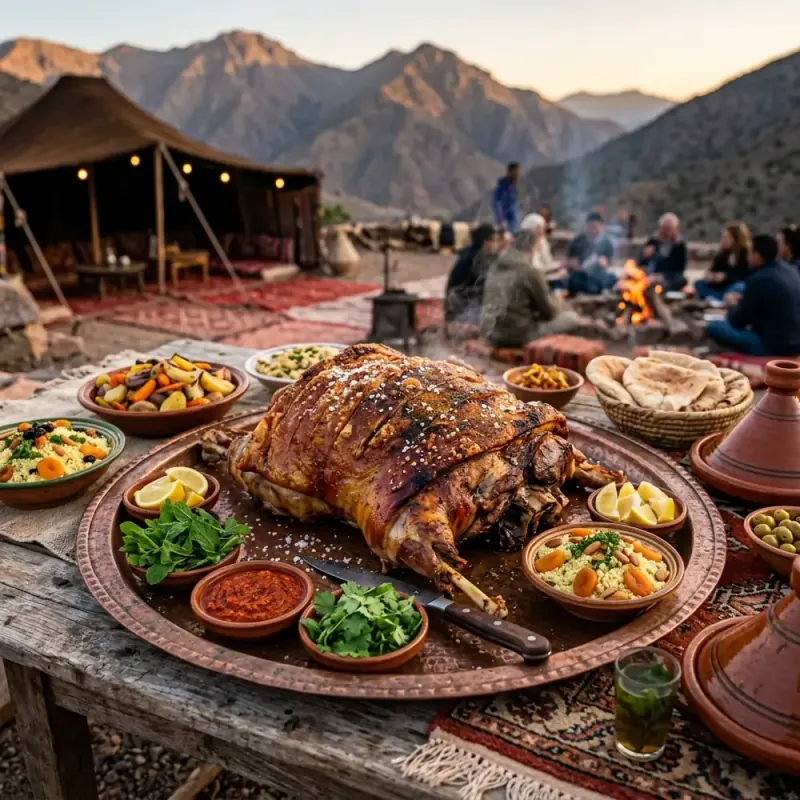
To serve, the meat is piled on a communal platter, the syrupy raisins are spooned over the top, and it is generously garnished with blanched, fried almonds and toasted sesame seeds.
The Invisible Invitation
You are sitting in a Moroccan home on the fourth day of Aid el-Adha. The air in the house has been heavy with the smell of roasting meat and spices for days. The Mrouzia is brought to the table. It is dark, glossy, and covered in golden almonds. Tear off a piece of bread. When you dip it into the sauce, the syrup is so thick it threatens to pull the bread apart. The first flavor is pure honey and cinnamon, immediately followed by the deep, earthy punch of the Ras el Hanout and the rich, melted fat of the lamb. It is decadent, heavy, and completely satisfying. It is the taste of a feast designed to outlast the season.
SEO Meta Description: What is Moroccan Mrouzia? Discover the traditional recipe for this sweet and savory lamb tagine made with honey, raisins, almonds, and Ras el Hanout during Aid el-Adha.
Experience the true heart of Moroccan heritage through its traditions. Join us in preserving these ancestral rituals.
What People Are Saying
No comments yet. Be the first — we'd love to hear from you.
Fatima-Zahra Benali
A Moroccan cultural writer dedicated to documenting the authentic voice, history, and heritage of the Kingdom. Writing from within — to share what truly makes Morocco extraordinary.
Our Mission →