Msemen: The Moroccan Flatbread That Looks Simple and Isn't
Msemen: What Actually Makes a Good One and Why Yours Probably Isn’t There Yet
Let me say something that will get me in trouble with various people I respect: Msemen is deceptively difficult. Not complicated in the way that French pastry is complicated — not a list of precisely measured ingredients and temperature-controlled steps — but difficult in the way that any technique-dependent thing is difficult, which is that you have to fail at it many times before your hands know what right feels like. And your hands are the whole point.
I have been watching women make Msemen since before I could see over a kitchen counter. My aunt in Casablanca makes the best ones I have ever eaten. She cannot explain how she makes them. I have watched her do it a hundred times and I can describe what I see, but even that description misses something that lives only in the pressure of her palms against the oiled surface and the instinct that tells her when to stop stretching and when to fold.
This is the honest situation with Msemen. I’ll tell you everything I know. The rest you have to feel for yourself.
What Is the Difference Between Msemen, Meloui, and Rghaif?
This causes genuine confusion among people new to Moroccan bread, and honestly, within Morocco too — different regions use these names slightly differently, which makes a definitive answer impossible. But here is the rough distinction as I understand it.
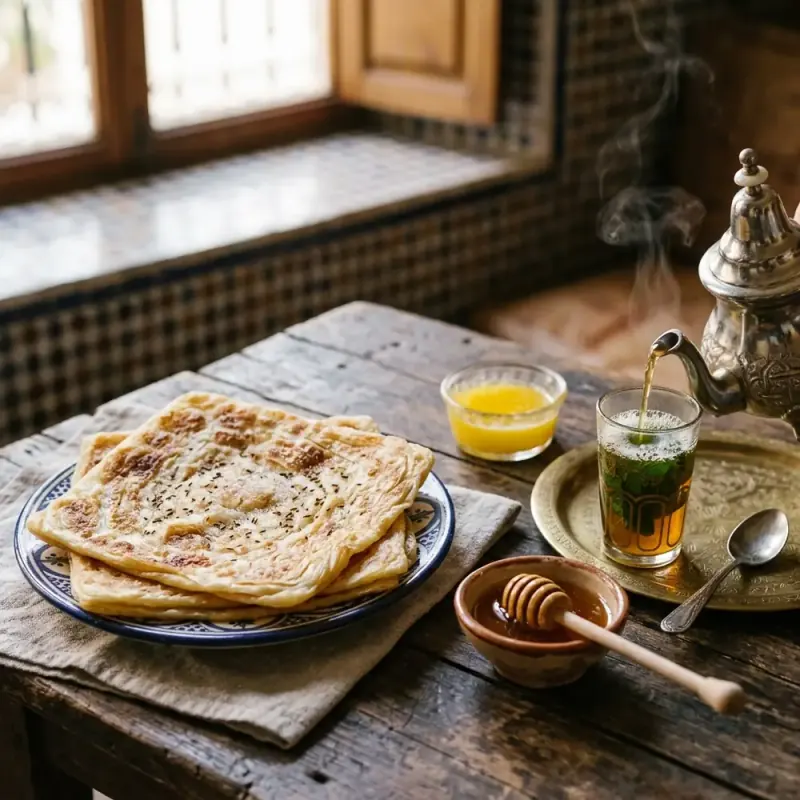
Msemen (the name comes from the Darija word for clarified butter, Smen) is the square flatbread. It is folded into a square shape before its final cooking and has a characteristic layered interior — when you pull it apart, you get thin, translucent sheets of dough separated by butter and semolina, like a rough puff pastry flattened on a griddle.
Meloui is round and follows the same laminated technique but is rolled into a cylinder, then coiled into a spiral before being flattened for cooking. Its interior layers are tighter and more concentric. It is chewy in a different way — more elastic, less flaky.
Rghaif is often used interchangeably with Msemen in some regions, particularly in the north and in some Fes households. Elsewhere, Rghaif refers specifically to a thinner, crisper version. I have had this argument at multiple family tables and nobody wins.
What they share is the lamination technique — the repeated folding and layering with fat (usually a mixture of vegetable oil and Smen) and fine semolina — that creates the interior structure. Master that technique and you can make all three.
What Goes Into the Dough and Why Does the Ratio Matter?
The dough for Msemen is a mixture of fine semolina and plain white flour. The ratio is where people disagree, and where the texture outcome diverges most significantly.
More semolina produces a firmer, more granular texture with a slight golden color and a slightly crunchier exterior. More flour produces something softer, more elastic, pale, and with a chewier interior layer. My preference — and I acknowledge this is personal — is approximately two parts flour to one part fine semolina. It gives you enough structure to stretch the dough thin without tearing but enough semolina to develop the slightly gritty, satisfying bite that makes a good Msemen feel substantial rather than just soft.
Salt goes in. Warm water goes in. A small amount of active dry yeast — just enough to give the dough a slight rise without making it bread-like. Some cooks add a small spoonful of sugar to feed the yeast; others don’t and consider the sugar unnecessary. Both approaches produce good results.
The dough is kneaded until very smooth — significantly smoother than bread dough, because it needs to be stretched almost paper-thin without tearing. If it tears during stretching, you need another five minutes of kneading. Rest the dough for 30 minutes covered, then divide into balls roughly the size of a large egg.
What Is the Lamination Step and How Do You Do It Without Destroying the Dough?
This is everything. The rest is just bread.
You need two things on your work surface: a thin film of vegetable oil (not flour — flour will make the dough tough), and a small bowl of fine semolina. In a separate small bowl, have your Smen or butter softened to room temperature.
Take a ball of dough. Place it on the oiled surface. Using the flat of your palms — not your fingertips, which will poke holes — push outward from the center in all directions simultaneously, stretching the dough as thin as you can get it without it tearing. You are aiming for something close to transparent. Hold it up to the light: if you can see the shape of your hand through the dough, you are close to right.
Now smear a thin, even layer of softened Smen over the entire surface. Then scatter a light dusting of semolina over that — not thick, just enough to create separation between the layers. The semolina is the key that most written recipes don’t emphasize enough: it is what keeps the layers actually separate when the bread cooks, instead of fusing back together.
Fold the dough in thirds from one side, then fold again in thirds from the other direction to create a rough square. You now have a small, thick square of layered dough. Let it rest for two minutes. Then gently re-flatten it with your palms — no rolling pin, palms only — until it’s about half a centimeter thick.
Cook on a dry, hot griddle or cast iron pan over medium heat. Two to three minutes per side. The outside should develop golden patches and some faint char spots. The inside should be soft, steaming, and when you pull it apart, should reveal the layers clearly.
The Invisible Invitation
It is seven in the morning in my aunt’s kitchen in Casablanca. She is already at the stove with four Msemen going simultaneously on two pans, moving them by hand — no spatula, she never uses a spatula — and stacking the finished ones in a cloth-lined basket that sits near the gas flame to stay warm. The smell of cooking butter and dough is so specific to this kitchen, this hour, this woman, that I could not separate them from each other if I tried. Tea is ready. The honey jar is already open. Sit down. Everything is warm.
SEO Meta Description: How is Moroccan Msemen made? A step-by-step guide to the lamination technique, semolina ratio, and the difference between Msemen, Meloui, and Rghaif — from a Fassi culinary expert.
Experience the true heart of Moroccan heritage through its traditions. Join us in preserving these ancestral rituals.
What People Are Saying
No comments yet. Be the first — we'd love to hear from you.
Khadija Tahiri
A Moroccan cultural writer dedicated to documenting the authentic voice, history, and heritage of the Kingdom. Writing from within — to share what truly makes Morocco extraordinary.
Our Mission →