Ras el Hanout: The Spice Blend Nobody Agrees On and Everybody Uses
Ras el Hanout: An Honest Attempt to Explain a Spice Blend That Resists Definition
I want to be upfront about something: there is no single correct Ras el Hanout. I know this undermines the authority of everything I am about to tell you, but I think it is more useful than pretending there is a definitive version, because the pretense leads to the kind of disappointment that happens when you make a recipe that calls for “Ras el Hanout” with a blend you bought in a supermarket and find that the result bears no resemblance to what you ate in Fes.
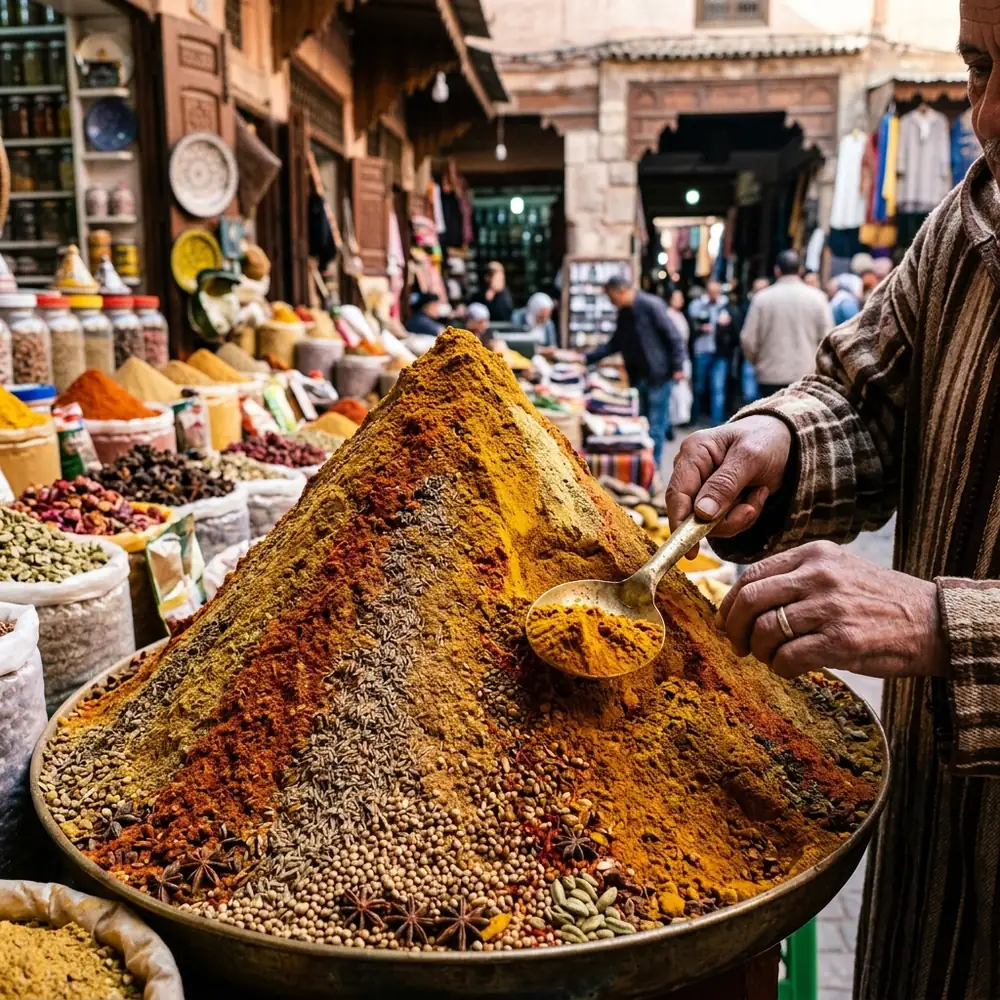
The name means “head of the shop” — the merchant’s best, his signature product, the blend he is most proud of and most protective of. No two merchants in Morocco blend it the same way. A serious attar (spice merchant) in the Fes medina might use between twenty and forty individual spices, sourcing some of them from places he won’t name, combining them in proportions he has developed over years and will not share with his competitors. The blend in the small paper packet he hands you is a commercial secret disguised as a cooking ingredient.
This is wonderful and maddening in equal measure.
What Spices Commonly Appear in Ras el Hanout?
Despite the individual variation, certain spices appear consistently enough across different merchants’ and families’ blends to constitute a kind of skeleton — the minimum shared vocabulary of Ras el Hanout, around which each maker builds their personal interpretation.
Almost every version contains: cumin, coriander seed, ginger (usually dried and ground), turmeric, black pepper, cinnamon, cardamom, and sweet paprika. These eight are the baseline. A blend without most of these is not really Ras el Hanout in any recognizable sense, just a spice mixture.
Beyond the baseline, the complexity of a Ras el Hanout comes from what gets added to distinguish it. Nutmeg and mace (the two products of the same tree, used together for layered depth). Allspice, which provides a clove-cinnamon-pepper combination in a single ingredient. Dried rose petals — and this one surprises people — which contribute a subtle floral note that lifts the heavier spices and is particularly important in preparations where the blend is used with lamb and dried fruit. Cubeb pepper, a milder, slightly floral relative of black pepper. Long pepper, which has a more complex heat profile than standard black pepper. Grains of paradise, an African peppercorn with gingery warmth. Dried lavender. Orris root. Galangal.
The more elaborate blends include spices that were historically used in small quantities for their medicinal and aromatic properties rather than their flavor dominance: dried hanout flowers, ash berries, monk’s pepper (kif habba — not cannabis, a different plant entirely despite the similar name), and, in the oldest traditional formulations, small quantities of Spanish fly — a historical aphrodisiac ingredient whose presence in Ras el Hanout was openly acknowledged for centuries before Western food media discovered it and created a minor moral panic in the early 2000s. Spanish fly is genuinely toxic in significant quantities and is not present in any modern commercial blend.
How Should Ras el Hanout Be Used and When Does It Go Wrong?
The most common error with Ras el Hanout outside Morocco — in international recipes that incorporate it — is using it as a rub applied directly to a protein’s surface before high-heat cooking. Ras el Hanout contains aromatic compounds that volatilize rapidly at high temperatures. A blend applied to a lamb chop and then put under a hot grill will produce a scorched, bitter crust where the spice surface burns before the interior of the meat is cooked. The aromatic complexity you paid for is gone. You have burnt spice.
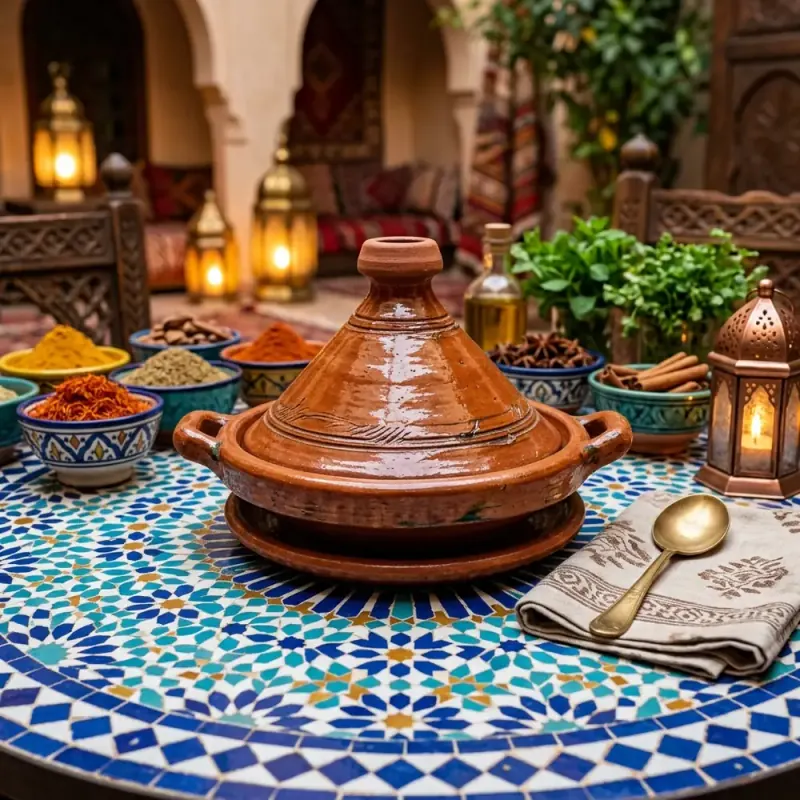
The correct treatment — in our ancestral culinary tradition, which developed around tagine and slow cooking rather than high-heat grilling — is to bloom the Ras el Hanout in warm fat before the other ingredients go in. The blend goes into the oil or smen with the onions, cooked over low to medium heat for three to four minutes until the fragrance blooms fully and the raw edge disappears. Then the protein goes in, coated with the spiced fat. Then the liquid. This way the spices flavor the entire cooking environment rather than sitting on the surface where they will either burn or remain raw.
For dry applications — if you are using Ras el Hanout as a dry rub for meat that will be slow-roasted or slow-grilled at low temperature — the surface heat never reaches the point where burning is an issue and the application is fine.
The quantity most recipes call for is too conservative. One teaspoon for a tagine serving four is invisible. Two tablespoons — and this is not a mistake in the quantity — is a starting point for a dish where you want the spice blend to be the flavor statement. Taste and adjust from there.
Can You Make a Good Ras el Hanout at Home?
Yes. It will not be identical to what a Fes attar produces, because you do not have his specific sourcing relationships and his years of adjusting the blend to his own nose. But a home blend made from fresh, high-quality individual spices will be considerably better than most pre-packaged products sold in supermarkets, which are frequently made from older stock, blended in bulk, and lack the volatile aromatic freshness that gives a good Ras el Hanout its character.
Grind the whole spices fresh if possible. Buy cardamom pods and crack them yourself rather than buying pre-ground cardamom — the volatile oils in cardamom dissipate very rapidly after grinding and a pre-ground product from a supermarket shelf has often lost most of what makes it interesting. Same principle applies to coriander seed and black pepper.
Toast the whole spices lightly in a dry pan before grinding — just enough heat to wake the volatile compounds without burning. Then grind, combine with the pre-ground additions (turmeric, paprika, dried ginger), and store in a sealed glass jar away from light. Use within three months.
The Invisible Invitation
The attar’s stall in the Fes medina is narrow and floor-to-ceiling with jars, bags, and open sacks, and the smell when you step in from the alley is immediate and dense — cumin and rose and cinnamon all at once, plus a dozen things underneath that you cannot name individually. He watches you look at things for a moment, then says: “What are you making?” Tell him. He will build you a blend. He will not tell you what is in it. Take it home, bloom it in warm butter with onions, and then come back next year and ask him to make it again. It will be different. That is the point.
SEO Meta Description: What is Moroccan Ras el Hanout? The spice blend’s ingredients, no-fixed-recipe history, correct cooking technique, and a guide to making your own from scratch.
Experience the true heart of Moroccan heritage through its traditions. Join us in preserving these ancestral rituals.
What People Are Saying
No comments yet. Be the first — we'd love to hear from you.
Khadija Tahiri
A Moroccan cultural writer dedicated to documenting the authentic voice, history, and heritage of the Kingdom. Writing from within — to share what truly makes Morocco extraordinary.
Our Mission →