Tadelakt: The Waterproof Plaster of Marrakech, Powered by Olive Soap and River Stones
Tadelakt: The Polished Lime of Marrakech
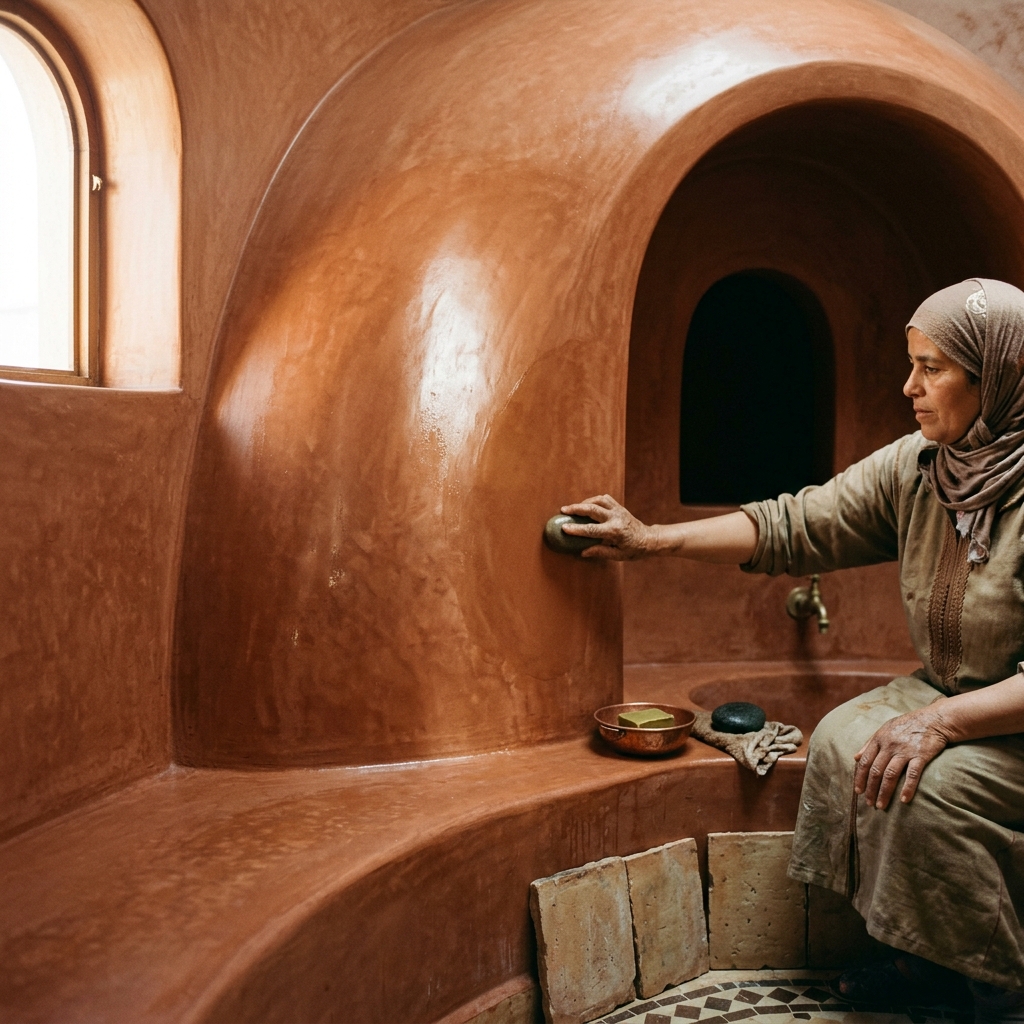
If you walk into a beautifully restored riad in the medina of Marrakech, or if you visit a traditional hammam anywhere in Morocco, you will notice the walls. They are often slightly curved, lacking sharp corners or grout lines. They possess a soft, warm sheen that is completely distinct from modern paint or polished marble. They look soft, almost like leather, yet they are completely solid and entirely waterproof.
This is Tadelakt, an ancient Moroccan plastering technique that translates from Tamazight (the Amazigh language) to mean “to rub” or “to massage.”
Tadelakt is arguably the most famous and luxurious architectural finish to emerge from Morocco. But its reputation as a luxury product obscures its highly practical, utilitarian origins: it was invented to line the massive underground cisterns (khettaras) that stored the city’s drinking water.
The Chemistry of Tadelakt: Lime and Olive Soap
The magic of tadelakt lies in a specific chemical reaction between two entirely natural, locally sourced materials: lime and black olive soap.
1. The Marrakech Lime: True tadelakt begins with lime sourced from the region of Marrakech. The limestone here contains specific impurities (clays and minerals) that make it naturally hydraulic — meaning it sets harder and is more resistant to water than standard lime. The limestone is burned in primitive kilns for days, slaked with water, and sifted into a fine powder.
2. The Black Soap (Savon Beldi): This is the same dark, gelatinous soap used for exfoliating the skin in the hammam. It is made from macerated black olives, olive oil, and potash.
When the alkaline lime plaster is applied to the wall and the fatty acid of the olive soap is rubbed into it, a chemical reaction occurs. The mixture undergoes saponification, forming an insoluble, waterproof layer of calcium stearate. This is what makes tadelakt repel water perfectly.
The Labor: Polishing with the River Stone
The name “tadelakt” (to rub) refers to the incredibly labor-intensive application process. Tadelakt is not painted on; it is physically forced into the wall.
An artisan (maalem) applies the lime plaster in two coats. Before the second coat dries completely, the surface is smoothed with a wooden float. Then, the true work begins. The artisan takes a smooth, flat river stone (usually basalt or agate, worn perfectly smooth by centuries of water flow). They coat the wall in a solution of black soap and water, and they begin to rub the stone in small, tight circles against the plaster.
This polishing process requires immense physical pressure. The stone compresses the lime, forcing the air out, driving the soap into the pores of the plaster, and creating a microscopic, seamless, waterproof seal. The artisan must feel the tension of the wall, knowing exactly how much pressure to apply and when to stop before the plaster tears.
Because it cannot dry out before the polishing is finished, tadelakt requires a team working continuously. A large wall might take several men an entire day of constant, rhythmic rubbing.
The Aesthetic Imperfection
Tadelakt is rarely perfectly flat. The pressure of the river stone leaves subtle, undulating traces across the surface. Because it is tinted with natural earth pigments (ochre, saffron, indigo, crushed brick), the color is never completely uniform; it has depth, mottling, and variations that react beautifully to light.
Over time, tadelakt ages gracefully. It may develop microscopic hairline cracks (faïençage), which do not compromise its waterproof nature but add to its antique patina.
The Invisible Invitation
Step into the hot room of a traditional hammam. The air is thick with steam. Look at the walls and the arched ceiling. There are no tiles, no grout lines where mold can grow, no sharp corners. The entire room is a single, continuous, undulating surface of deep red or charcoal tadelakt. Touch the wall. It is warm, incredibly smooth, and completely impervious to the condensation running down it. You are not looking at a modern waterproofing membrane; you are looking at crushed rock, olive oil, and the thousands of circular movements of an artisan’s river stone.
SEO Meta Description: What is Moroccan tadelakt? Learn about the traditional waterproof lime plaster of Marrakech, the chemical reaction with black olive soap, and the labor-intensive polishing process using river stones.
Experience the true heart of Moroccan heritage through its traditions. Join us in preserving these ancestral rituals.
What People Are Saying
No comments yet. Be the first — we'd love to hear from you.
Khadija Tahiri
A Moroccan cultural writer dedicated to documenting the authentic voice, history, and heritage of the Kingdom. Writing from within — to share what truly makes Morocco extraordinary.
Our Mission →