Taliouine Saffron: Why Morocco Grows Some of the World's Best and What That Means for the Price
Taliouine Saffron: The Arithmetic of Why It Is Expensive and Why It Is Worth It
Saffron is the most expensive spice in the world by weight. This is not a marketing claim — it follows directly from the arithmetic of its production, which I will state plainly because the arithmetic makes the price completely understandable rather than arbitrary.
The saffron crocus (Crocus sativus) flowers once per year, in October, for approximately two weeks. Each flower contains three red stigmas — the part of the plant that is saffron. The stigmas must be picked by hand, from each flower, within the day of the flower’s opening: the stigmas degrade rapidly after the flower opens, and the window for harvest is approximately eight hours per flower. A kilogram of dried saffron requires approximately 150,000 flowers and the manual labor to harvest 450,000 individual stigmas.
No machine has been designed that can harvest saffron stigmas efficiently at scale without significant quality loss — the delicacy of the stigma and the variability of the plant’s flowering timing make mechanical harvesting impractical. The harvest is human labor, family labor, neighbor labor, organized across the brief October window in the communities where the crocus grows.
The Taliouine valley in the Anti-Atlas mountains, at an elevation of approximately 1,200 meters, has been producing saffron for at least five centuries. The specific combination of its climate — dry, sunny days with significant diurnal temperature variation, the mountain cold of the Anti-Atlas nights — and its soil composition produces a saffron with chemical characteristics that laboratory analysis has repeatedly ranked among the best in the world: high crocin (the pigment that gives saffron its color, the primary quality indicator), high safranal (the compound that gives saffron its characteristic aroma), and low moisture content.
What Does High-Quality Saffron Look Like and How Is It Identified?
The adulteration of saffron is among the most common spice frauds, both because of the price differential and because the detection requires some knowledge. What legitimate saffron looks like:
The stigmas are deep red to red-orange with a slight curl at the tip and a slightly lighter, more orange end at the base where they connect to the flower. They should be brittle when dry — snap cleanly when bent — and should release a color (crocin) immediately when dissolved in warm water, turning the water a vivid, saturated yellow-orange within thirty seconds. The smell is distinctive: intensely floral, slightly metallic, with an almost honey-like sweetness underneath — it is a smell that resists easy description but is unmistakable once learned.
Adulterated saffron includes: safflower petals dyed red (which dissolve to a less saturated, more orange color in water, fade quickly, and have no safranal aroma); dried corn silk dyed red (larger stigmas, less uniform, no water-soluble crocin); pomegranate filaments (also dyed, without the characteristic smell). The most sophisticated adulterations add additional moisture to increase weight — legitimate dried saffron should have less than 12% moisture content, and water-added saffron can appear visually identical while weighing more.
The simplest test: dissolve a few threads in warm water. Genuine saffron turns the water vivid yellow in under a minute and retains its color for hours. Adulterated saffron fades quickly or turns a different color entirely.
What Is Saffron’s Role in Moroccan Cooking and How Much Should You Use?
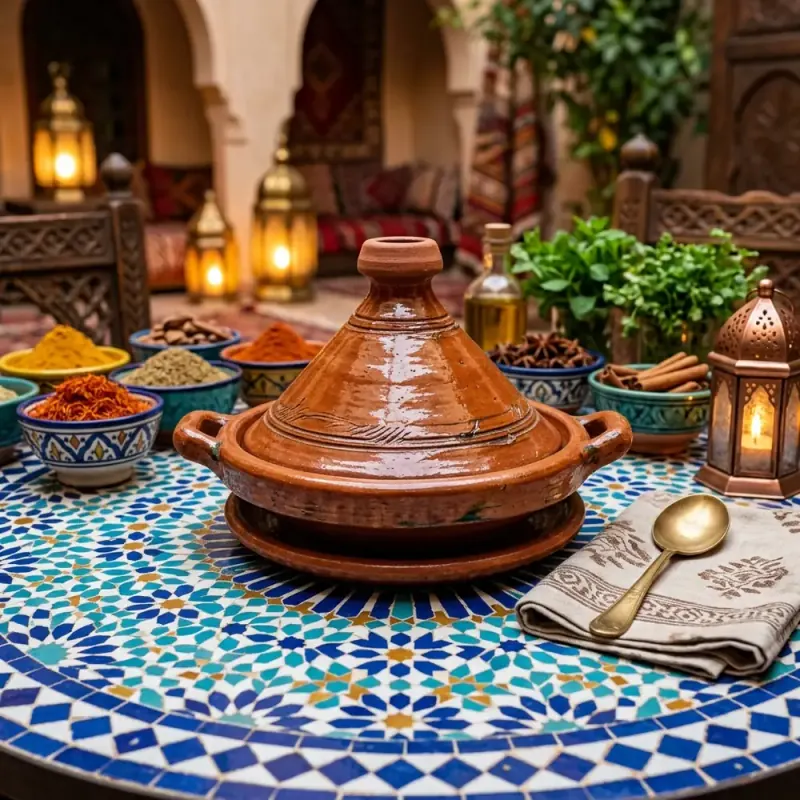
In Moroccan cooking, saffron is a structural ingredient — not a garnish, not optional — in a range of dishes from harira to bastilla to chicken tagine to kdra. Its function is simultaneously flavoring (the safranal provides its specific floral-metallic note), coloring (the crocin turns the dish’s braising liquid a golden-amber), and something that doesn’t have a good name in English — a specific warming, rounding quality it adds to spice blends that makes all the other spices cohere rather than compete.
The quantity used in genuine Moroccan home cooking is a topic on which I have strong opinions: it is more than most international recipes indicate. A tagine for four people uses approximately half a gram of saffron — a generous pinch, perhaps twenty threads — and this quantity should be dissolved in a tablespoon of warm water before adding to the dish, which extracts the crocin more efficiently than adding the dry threads directly to a cold preparation.
Adding saffron to a cold or room-temperature liquid and then heating it is less efficient than dissolving in warm water first. The warm water extraction releases the crocin immediately, and you can see the vivid yellow-orange color in the small tablespoon of liquid before it goes into the tagine. Adding those ten minutes of pre-dissolution produces a noticeably more saturated color and a more evenly distributed flavor than simply tossing the threads in.
What Is the Taliouine Saffron Cooperative and Why Does It Matter?
The Coopérative Soktane Souktana du Safran de Taliouine — one of the main producer cooperatives in the region — brings together Taliouine’s saffron-producing families for collective marketing, quality control, and price negotiation with buyers. The cooperative model has been important in ensuring that a larger share of the final saffron price returns to the farming families rather than being absorbed by intermediaries.
Purchasing directly from the cooperative or from verified Taliouine producers is both the best way to ensure you are buying genuine Taliouine saffron and the most direct support for the families who grow it. The cooperative sells online and through several Moroccan food export channels. The price per gram will be higher than the small envelopes of unverified saffron sold in Moroccan medina spice shops — and it should be higher, because it is the genuine article from verified origin.
The Invisible Invitation
It is the third day of October and the Taliouine crocus fields have opened overnight. This happens suddenly — the flowers wait, then open together across the valley floor in a morning. Every family in the village is in the fields by dawn, moving along the rows, picking each flower’s three stigmas with two fingers in a motion so practiced it is invisible as a motion. The children come too — this is the week when school attendance in Taliouine is informally understood to be secondary to the harvest. By midday, the stigmas are being dried on cloth spread in the sun on rooftops. The smell of drying saffron over an entire village is a very specific thing that I have experienced twice in my life. The only description I can give is: imagine the smell of the best harira you have ever tasted, concentrated and raw and aerial. That is approximately what it is. Come in October if you want to understand what saffron is before it becomes a spice.
SEO Meta Description: What makes Taliouine saffron special? The anti-Atlas production, crocin quality metrics, adulteration tests, correct cooking quantities, and the producer cooperative supporting farming families.
Experience the true heart of Moroccan heritage through its traditions. Join us in preserving these ancestral rituals.
What People Are Saying
No comments yet. Be the first — we'd love to hear from you.
Youssef Amazigh
A Moroccan cultural writer dedicated to documenting the authentic voice, history, and heritage of the Kingdom. Writing from within — to share what truly makes Morocco extraordinary.
Our Mission →